Dual Boiler vs Heat Exchanger Espresso Machines (2026)
For a home coffee bar the dual boiler is the better buy: the Breville Dual Boiler at under $2,500 costs less than the Nuova Simonelli Oscar II heat exchanger at under $2,500, sets brew temperature to a number and needs no cooling flush. Choose a heat exchanger only if you steam milk like a cafe and want commercial steam power per dollar, in which case the Lelit MaraX removes the flush routine and the Rocket Appartamento gives you the biggest boiler in the class.
A heat exchanger heats brew water on demand in a tube passing through a single steam boiler, so one boiler does both jobs at once. A dual boiler uses two separate boilers, one held at brew temperature and one at steam temperature. Both give you simultaneous brewing and steaming, which is the reason anyone shops in this part of the market at all. They differ on how brew temperature is set, on whether you have to flush before a shot, and, at home prices, on cost in a direction that surprises most people.
How does each architecture actually work?
In a heat exchanger, the boiler is held at steam temperature all the time. Running through it is a tube, the exchanger, carrying fresh water from the tank to the group. Water passing through that tube picks up heat on the way, arriving at the coffee at roughly brewing temperature while the boiler itself stays hot enough to steam. One vessel, one element, both jobs, simultaneously.
In a dual boiler, there are simply two boilers. One is held at brew temperature, typically under PID control, and feeds the group. The other is held at steam pressure and feeds the wand. Nothing is shared, so nothing is compromised, and the two temperatures are independent numbers you set.
Both architectures usually sit behind an E61 group or an equivalent, and both take a long time to warm up, because the thermal mass of a boiler and a brass group is what stabilises temperature and thermal mass takes time to heat. Plan on tens of minutes for either, and use a plug timer.
What is the cooling flush, and how much does it really cost you?
This is the honest part of the heat exchanger story, and coverage of it tends to go to one of two extremes.
Between shots, the water sitting inside the exchanger is not moving. It is surrounded on all sides by boiler water at steam temperature, so it keeps absorbing heat until it is far hotter than the 90 to 96 C coffee wants. Brew with it and the shot is scorched: bitter, drying, ashy, and no grind change will fix it because the problem is not the grind.
The fix is the cooling flush. You run the group for a couple of seconds before locking in the portafilter, watching for the flow to settle from a spitting hiss into a smooth stream. That pushes the superheated water out and pulls fresh tank water into the exchanger.
Two seconds is nothing, and that is why heat exchanger owners are dismissive about it. But the honest accounting includes the parts nobody mentions: the flush length depends on how long the machine has been idle, so it is a judgement rather than a fixed routine; you are throwing away water and heating it again; and anyone else in the household who uses the machine has to learn it too, or their shots will taste burnt and they will blame the beans. It is a small tax paid on every session, forever.
The Lelit MaraX is the notable exception. It manages boiler temperature around brew stability instead of steam pressure, which removes the flush routine in normal use and is the main reason it is so widely recommended as a first machine of this type. The Rocket Appartamento is the traditional approach: no PID, brew temperature managed by boiler pressure and by the flush, and a 1.8 litre boiler that steams like a cafe machine in exchange.
What does each architecture cost in a real machine?
Here is where the usual advice is out of date. Heat exchangers were historically the cheaper route to simultaneous brewing and steaming, because one boiler is cheaper to build than two. That is still true in the factory, and it is no longer true on the shelf, because the heat exchanger machines sold for home use are commercial-derived equipment while the cheapest dual boilers are countertop appliances built to a price.
| Machine | Architecture | PID | Portafilter | Cooling flush | Price |
|---|---|---|---|---|---|
| Lelit MaraX | Heat exchanger | Yes | 58 mm | No, managed by the control system | $1,000 to $2,000 band |
| Rocket Appartamento | Heat exchanger | No | 58 mm | Yes | $1,000 to $2,000 band |
| Nuova Simonelli Oscar II | Heat exchanger | No | 58 mm | Yes | Under $2,500 |
| Breville Dual Boiler | Dual boiler | Yes, on both | 58 mm | No | Under $2,500 |
| Diletta Bello+ | Dual boiler | Yes, on both | 58 mm | No | Under $2,500 |
Sources: boiler layout, PID and pressure figures from Breville, Nuova Simonelli, Diletta, Lelit and Rocket product documentation; the cooling flush behaviour of heat exchanger machines as described in those manufacturers' manuals and published barista guidance. Prices are Amazon list prices checked in 2026.
The Breville Dual Boiler at Under $2,500 undercuts the heat exchanger Nuova Simonelli Oscar II at Under $2,500 by under $500, while giving you two PID-controlled boilers, an adjustable over-pressure valve and a shot clock. Meanwhile the Diletta Bello+ , a full E61 dual boiler with PID on both circuits, costs Under $2,500, which is under $100 less than the heat exchanger Oscar II. The old money argument for a heat exchanger has largely evaporated at these prices.
One of each architecture
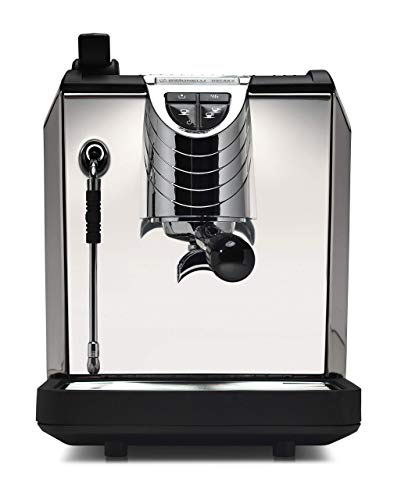
Nuova Simonelli Oscar II Espresso Machine
A heat exchanger with a commercial group and the option to plumb it in, so it steams and brews at the same time without waiting.
Check price
Diletta Bello+ Espresso Machine, Stainless Steel
A dual boiler with PID on both circuits and an E61 group, which is the classic prosumer specification rather than a countertop appliance interpretation of it.
Check priceBudget bands are a guide; confirm the current price on Amazon. As an Amazon Associate we earn from qualifying purchases.
Which one steams better?
The heat exchanger, per dollar, and it is the strongest remaining argument for the architecture. A heat exchanger dedicates its entire boiler to steam, and those boilers are large: the Appartamento carries 1.8 litres. A dual boiler splits its budget across two vessels, so the steam boiler in a home dual boiler is usually smaller than the single boiler in a comparable heat exchanger.
In practice that shows up as recovery rather than as raw power. Texturing one 12 oz pitcher is within reach of any machine here. Texturing six in a row, which is what a home bar does when people come over, is where a big steam boiler keeps going and a small one starts dropping pressure between drinks.
Milk technique matters more than either. Texture to 55 to 65 C, because above roughly 70 C the proteins denature and the milk tastes scalded, and lactose sweetness peaks near 60 C. A cafe-power wand does not save milk you have taken too hot.
Which one gives you more control over the shot?
The dual boiler, without qualification. Brew temperature is a number you set and the PID holds, independently of how much steam pressure you want. That matters if you switch between roast levels, because lighter roasts want the top of the 90 to 96 C range and darker roasts the bottom, and on a conventional heat exchanger your brew temperature is a consequence of boiler pressure and flush length rather than a setting.
That is why a PID heat exchanger such as the MaraX is a genuinely different proposition from a traditional one such as the Appartamento or the Oscar II. It is also why, if you have arrived at this comparison because you want to dial temperature deliberately, the answer is a dual boiler and the rest of this page is detail.
| Question | Heat exchanger | Dual boiler |
|---|---|---|
| Brew and steam at the same time | Yes | Yes |
| Number of boilers to heat and descale | One | Two |
| Set brew temperature to a number | Only with PID models | Yes |
| Cooling flush before the first shot | Usually yes | No |
| Steam power per dollar | Higher | Lower |
| Warm-up from cold | Long | Long |
| Parts count and electronics | Fewer | More |
Who should buy each one?
Buy a heat exchanger if milk is the centre of your coffee life. If you make four or more milk drinks in a session, entertain regularly, or simply want the wand to behave like the one at your cafe, a large single steam boiler is the most steam per dollar available. Buy one also if you prefer fewer things to go wrong: one boiler, one element, one thermostat or pressurestat, and a simpler machine to service in year ten. The MaraX is the version for people who do not want to learn a flush routine; the Appartamento is the version for people who want the biggest boiler and do not mind one.
Buy a dual boiler if you want brew temperature to be a number rather than a technique, if you switch between light and dark roasts, if more than one person will use the machine and you do not want to teach them a flush, or if you are shopping in the band where the dual boiler is simply cheaper. The Breville Dual Boiler is the value answer and the Diletta Bello+ is the traditional E61 answer with standard commercial fittings and a much longer expected parts life.
Who should buy neither?
Anyone whose grinder cost less than $400. Both architectures are ways of removing waiting, not ways of improving extraction. Grind quality sets the ceiling on what any machine produces, so the correct next purchase for that reader is a MiiCoffee DF64 II Single Dosing Coffee Grinder at under $500 or a Eureka Mignon Specialita Espresso Grinder at under $1,000, not a second boiler. This is the most expensive mistake in home espresso and it is made constantly at exactly this price point.
Anyone making one or two drinks a day. A single boiler wastes 30 to 60 seconds each way and costs a quarter as much. If that wait is not currently annoying you, neither architecture here will improve your coffee, and the case is set out in single boiler versus dual boiler. A Gaggia RI9380/49 Classic Evo Pro Espresso Machine at under $500 with a serious grinder in front of it beats a four figure machine with a cheap one.
Anyone without the counter and the warm-up habit. These machines are heavy, deep and slow to heat. If the machine has to be moved, put away, or switched on and used within five minutes, buy a fast-heating machine and spend the difference on coffee.
What else does a machine at this level need?
A grinder in the same class, first and always. After that, the accessories that shape the puck: a precision 58 mm basket at under $50 with laser-cut holes and even spacing, a calibrated tamper and a distribution tool. Every machine on this page uses the 58 mm commercial standard, so all of it fits.
Water is the other line item, and at this price it is not optional. Espresso machines scale from calcium and magnesium, and the commonly cited target is roughly 50 to 100 ppm total hardness as calcium carbonate with alkalinity around 40 ppm. Above about 120 ppm, filtration or blended distilled water is the answer rather than more frequent descaling. A scaled heat exchanger tube is a workshop job, not a weekend one, and it is the most avoidable failure in this whole category.
We also have a full Breville Dual Boiler review.
Frequently asked questions
What is a heat exchanger espresso machine?
It is a machine with one steam boiler and a tube running through it that heats brew water on demand as it passes on the way to the group. Because the water is heated in transit rather than stored, one boiler can hold steam temperature continuously while still delivering brew-temperature water, so brewing and steaming happen at the same time from a single vessel.
What is a cooling flush and why does a heat exchanger need one?
Water sitting inside the exchanger between shots has been surrounded by steam-temperature boiler water, so it is far too hot for coffee. A cooling flush means running the group for a couple of seconds until the flow calms and the hiss stops, which pushes that superheated water out and pulls fresh water through. It takes longer to explain than to perform, but you do it before every first shot.
Is a dual boiler always better than a heat exchanger?
Not always, but usually for home use. A dual boiler lets you set brew temperature to a specific number independently of steam pressure, needs no flush, and at home prices is often cheaper because the heat exchanger machines sold for houses are commercial-derived. A heat exchanger wins on steam power per dollar and on having one boiler rather than two to heat, descale and eventually repair.
Does the Lelit MaraX really remove the cooling flush?
It changes the control logic so the boiler is managed around brew stability rather than steam pressure, which removes the flush routine in normal use. That makes it the easiest heat exchanger to live with, and it is why the machine is recommended so often as a first E61. The tradeoff is steam power under sustained milk work, which sits below a true dual boiler.
Which architecture uses less electricity?
A heat exchanger, in principle, because it holds one boiler at temperature rather than two. In practice both are machines you leave switched on or put on a timer, since warm-up is measured in tens of minutes for either. The real electricity question is whether the machine is on all day, not which architecture it uses, and a plug timer answers it for both.
Do either of these make better espresso than a good single boiler?
Only through temperature stability, and only if the grinder is already solved. Both architectures exist to remove waiting rather than to improve extraction, and grind quality sets the ceiling on what any machine can produce. A single boiler with a $500 grinder beats either of these with a $150 grinder, which is worth knowing before spending four figures on a boiler arrangement.
How we choose: we compare published manufacturer specifications, verified owner reviews and published barista guidance. We do not test gear in person. Espresso machines run mains electricity, pressurised water and steam above boiling point, so follow your manufacturer's manual and leave electrical or boiler work to a qualified technician. Everything here is researched guidance, not professional advice.