Best Espresso Grinders for Home in 2026
The MiiCoffee DF64 II at under $500 is the espresso grinder most people should buy: 64 mm flat burrs, stepless adjustment and near-zero retention, which is the specification most home baristas stop upgrading at. The Baratza Encore ESP at under $250 is the budget answer and gets about 90 percent of the result on medium and dark roasts, while the Eureka Mignon Specialita at under $1,000 is for a one-bean household that wants to set a grind once.
The MiiCoffee DF64 II at under $500 is the espresso grinder most people should buy, and it is the midrange pick on purpose. The Baratza Encore ESP at under $250 is the correct budget answer and it gets you most of the way there on medium and dark roasts. But the DF64 II is the grinder people stop upgrading at, and that is the most useful thing that can be said about any piece of coffee equipment. Stepless adjustment, 64 mm flat burrs and near-zero retention remove the three reasons owners of cheaper grinders keep shopping.
Why does grind size control a 25 second shot?
A grinder mills coffee beans into particles of a controlled size, and for espresso that size is the only variable that meaningfully sets how long water takes to pass through the puck. The machine supplies roughly 9 bar of pressure and water between 90 and 96 C. The coffee bed supplies the resistance. Change the resistance and you change the shot.
That relationship is direct and mechanical. Grind coarser and the gaps between particles widen, water moves faster, and 36 g comes out in 18 seconds having dissolved too little of the coffee. That shot reads sour and thin, and it is under-extracted. Grind finer and the bed tightens, water crawls, and the same yield takes 40 seconds while dissolving too much. That shot reads bitter, drying and ashy, and it is over-extracted. The target for extraction yield, the percentage of the dry coffee dissolved into the drink, is roughly 18 to 22 percent, and the conventional recipe that lands there is 18 g in, 36 g out, in 25 to 30 seconds.
Nothing else on the counter moves that number nearly as much. Dose changes it a little. Temperature changes the rate of extraction, not the flow. Tamp pressure, past the point of a level and consolidated bed, changes it barely at all. Grind is the dial, which is why an espresso grinder must be able to make very small, repeatable changes at a very fine setting, and why a grinder that cannot is not an espresso grinder regardless of what the box says.
A blade grinder fails this outright: it chops rather than mills and produces every particle size simultaneously, so part of the puck over-extracts while part is still under-extracted, in the same 25 seconds, in the same basket. The grind size chart puts espresso in context against every other brew method, and how to dial in espresso walks the adjustment process one variable at a time.
The three grinders worth most people's money

Baratza Encore ESP Coffee Grinder
The Encore body with espresso-capable burrs and 20 micro-adjustments inside the espresso range. Baratza publishes parts diagrams and sells every wear part, so it is repairable rather than disposable.
Best for: Pairing with a Bambino Plus or Gaggia Classic as a first proper setup.
Check price
MiiCoffee DF64 II Single Dosing Coffee Grinder
64mm flat burrs and stepless adjustment with near-zero retention, so you weigh beans in and get the same weight out. That is what makes single dosing different beans practical.
Best for: Anyone switching between espresso and filter, or between bags, more than once a week.
Check price
Eureka Mignon Specialita Espresso Grinder
Stepless 55mm burrs, a timed touchscreen dose and Eureka silent technology. Built to sit on a counter and grind the same drink every morning for years.
Best for: A one-bean household that wants to set a grind once and stop thinking about it.
Check priceBudget bands are a guide; confirm the current price on Amazon. As an Amazon Associate we earn from qualifying purchases.
On a tight budget, a hand grinder beats most cheap electric ones; see the best hand grinders for espresso from under $100.
If counter space rules out a separate grinder, see the best espresso machines with a built-in grinder and what you give up.
How do the real grinders compare on specifications?
Below are eight grinders with the figures their manufacturers publish. Where a burr diameter is not published we say so rather than repeat a number found on a forum, because a reader cannot tell an invented specification from a verified one. Note that retention and feed type vary independently of burr geometry: there are low retention conical grinders and high retention flat ones.
| Grinder | Burr type | Burr size | Adjustment | Retention | Feed | Price |
|---|---|---|---|---|---|---|
| Baratza Encore ESP | Conical | Not published | Stepped, 20 micro-adjustments in the espresso range | Moderate | Hopper | Under $250 |
| Breville Smart Grinder Pro | Conical | Not published | Stepped, 60 settings | Moderate | Hopper | Under $250 |
| Fellow Opus 2 | Conical | 48 mm | Stepless | Moderate | Hopper | Under $250 |
| Eureka Mignon Zero | Flat | Not published | Stepless, micrometric | Near zero, bellows path | Single dose | Under $500 |
| MiiCoffee DF64 II | Flat | 64 mm | Stepless | Near zero | Single dose | Under $500 |
| Baratza Sette 270 | Conical | Not published | Macro plus micro adjustment | Very low, straight-through path | Hopper or single dose | Under $500 |
| Fellow Ode Gen 2 | Flat | 64 mm | Stepped, tuned for filter | Low | Single dose | Under $500 |
| Eureka Mignon Specialita | Flat | 55 mm | Stepless, micrometric | Low for a hopper grinder | Hopper, timed dose | Under $1,000 |
The step from the Encore ESP to the DF64 II is under $250, and it buys stepless adjustment, flat burrs and single dosing at once. The step from the DF64 II to the Eureka Mignon Specialita is under $250, and it buys build quality, a timed dose and a quieter motor rather than better grinding. That is the honest shape of this market: the money curve flattens hard after under $500, and the two grinders on either side of that step are compared directly in Specialita versus DF64.
Other grinders worth shortlisting

Breville BCG820BSS Smart Grinder Pro
60 grind settings and a dose timer, and it grinds straight into a 54mm or 58mm portafilter with the supplied cradle.
Check price
Fellow Opus 2 Conical Burr Grinder
48mm burrs with stepless adjustment covering espresso through cold brew, in a body designed to be looked at rather than hidden.
Check price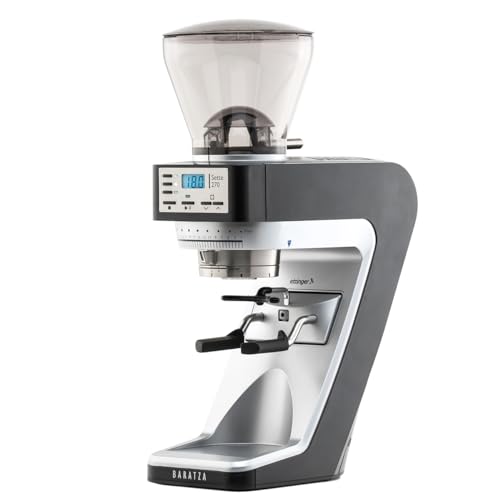
Baratza Sette 270 Conical Burr Coffee Grinder
A straight-through grind path with very low retention and macro plus micro adjustment. Fast, loud, and genuinely espresso-focused.
Check price
Eureka Mignon Zero Single Dose Espresso Grinder
A single dose hopper and a blow-up bellows path, so retention is close to nothing without giving up the Mignon build.
Find on Amazon
Fellow Ode Gen 2 Flat Burr Coffee Grinder
64mm flat burrs tuned for filter rather than espresso. Excellent at pourover, and deliberately not the right tool for a 9 bar shot.
Check priceBudget bands are a guide; confirm the current price on Amazon. As an Amazon Associate we earn from qualifying purchases.
Does stepped or stepless adjustment matter more for espresso than filter?
Considerably more, and the reason is the width of the useful window. A pourover recipe that takes 3 minutes tolerates a grind change that moves it to 3 minutes 20 seconds. Nobody rejects that cup. An espresso shot that takes 27 seconds does not tolerate a change that moves it to 38 seconds, because that is now a different and worse drink.
Stepped adjustment gives you fixed detented positions. On a general purpose grinder those steps are spaced for the whole brewing range from espresso to French press, which means at the espresso end one click can jump you clean past the target. On a grinder designed for espresso the steps are deliberately compressed: the Encore ESP provides 20 micro-adjustments inside the espresso range specifically to solve this, which is what separates it from the plain Encore at the same body price.
Stepless adjustment removes detents entirely, so you can land anywhere. The cost is that you cannot reliably return to a previous setting by counting clicks, which is why stepless grinders normally have a numbered or marked collar. For a household grinding one bean at one recipe, that is not a burden. For someone switching between espresso and pourover twice a day, a marked collar and low retention together are what make switching practical.
For filter brewing the calculation reverses. Stepped adjustment is easier to return to and the window is wide enough that the resolution loss costs nothing, which is precisely why the Fellow Ode Gen 2 Flat Burr Coffee Grinder at under $500 uses stepped adjustment and is deliberately not built to reach espresso fineness.
What is retention, and why does single dosing exist?
Retention is the coffee left inside the grinder after a dose, sitting in the chute and around the burrs until the next grind pushes it out mixed into fresh grounds. Every grinder has some. What varies is how much and whether it matters to you.
If you grind the same bean every morning, retention is close to irrelevant. What comes out today is yesterday's version of today's coffee, at the same grind setting, so the cup is unaffected and your dose is only off by the small difference between what went in and what came out.
If you switch beans, it matters a great deal. Every first dose after a change carries an unknown weight of the previous coffee, ground at the previous setting, which makes your ratio wrong and your dial-in slower. People solve this by purging, which means grinding and discarding 10 to 20 g of the new bean, and at specialty prices that is real money thrown away every time you open a bag.
Single dosing is the design answer. You weigh in exactly the dose you want, grind it, and get essentially the same weight out, usually helped by a bellows or a straight-through path. The MiiCoffee DF64 II is built around it, the Eureka Mignon Zero Single Dose Espresso Grinder at under $500 does the same on a Eureka chassis, and the conical Baratza Sette 270 Conical Burr Coffee Grinder at under $500 achieves very low retention through a straight-through grind path rather than through geometry.
Two cheap things make single dosing work in practice. A scale reading to 0.1 g at under $50 turns the dose from a guess into a number, and a dosing cup at under $50 lets you grind into a vessel, weigh it and invert it into the basket without spraying grounds across the counter.
Conical or flat burrs, honestly?
Conical burrs produce a wider bimodal particle distribution, meaning two clusters of particle sizes. Flat burrs produce a narrower unimodal one clustered around a single size. Because every particle extracts at its own rate, a wider spread extracts less evenly, and what you taste is the average of over-extracted fines and under-extracted boulders. That average reads as body, sweetness and roundness. A narrower spread extracts more uniformly and reads as clarity and separation, which is why flat is generally preferred for light roast single origins and conical for dark roast espresso in milk. Neither is a fault, conical is cheaper to align so it dominates below about $350, and a well built conical grinder beats a poorly built flat one every time. The full argument, with particle distribution and worked price examples, is in conical versus flat burr grinders.
Who should not buy the Eureka Mignon Specialita?
Anyone still using a pressurised basket. A pressurised basket has a single small outlet behind the filter plate and generates crema with a valve rather than with extraction. It exists so that pre-ground supermarket coffee produces something that looks like espresso, and it works by masking grind quality entirely. On that basket, a under $500 upgrade from the Encore ESP to the Specialita changes almost nothing in the cup, because the machine is no longer reading the grind. Swap to a non-pressurised basket first, which costs under $50, and only then does the grinder question become real.
Anyone brewing only medium and dark supermarket beans. Darker roasts are more soluble and more brittle, so they extract readily and forgive an imperfect particle distribution. On a bag of Lavazza Super Crema Whole Bean Coffee, 2.2 lb at under $25, the Encore ESP at under $250 gets roughly 90 percent of the result the Specialita would, and the remaining 10 percent is a clarity difference that dark roast espresso in milk largely hides. Buy the Specialita when you start buying single origins with a printed roast date, not before.
Anyone who switches beans weekly. This one is a workflow mismatch rather than a quality one. The Specialita is a hopper grinder with a timed dose, designed to sit on a counter and produce the same drink every morning for years. If you buy 250 g bags from different roasters, the hopper is a liability and every changeover costs you a purge. The Eureka Mignon Zero Single Dose Espresso Grinder at under $500 is the same Eureka build with a single dose hopper, costs less, and suits that reader far better.
And anyone who has not yet spent enough on the machine. An under-$1,000 grinder in front of a $200 pressurised-basket machine is money in the wrong place. The balanced totals are under $1,000 for a Breville Bambino Plus with the Encore ESP, under $1,000 for the Bambino Plus with the DF64 II, and under $1,000 for a Gaggia Classic Evo Pro with the DF64 II. The guide to choosing an espresso grinder works through the same decision without the product cards, and the espresso machine roundup covers the other half of every one of those totals.
Which grinder pairs with which machine?
Under $500 of machine, pair the Baratza Encore ESP at under $250 or the Fellow Opus 2 Conical Burr Grinder at the same price. Both grind fine enough for 9 bar, both are serviceable, and neither leaves you short on the machine. The Encore is the espresso-specific choice, the Opus 2 the stepless one with a wider overall range if you also brew filter.
Between $500 and $1,000 of machine, the MiiCoffee DF64 II at under $500 or the Eureka Mignon Zero Single Dose Espresso Grinder at under $500 is the right band. This is where most complete setups land, and it is the pairing that produces the biggest jump in cup quality per dollar anywhere in home espresso.
Over $1,000 of machine, the Eureka Mignon Specialita at under $1,000 stops being an indulgence, because a machine with stable temperature and a 58 mm commercial group can actually show the difference a narrower particle distribution makes. Below that, the machine is the bottleneck and the grinder money is partly wasted.
One caution on the shortlist above. The Fellow Ode Gen 2 Flat Burr Coffee Grinder at under $500 sits in the Expert tier of that card set because it is an excellent grinder, not because it is an espresso grinder. Its 64 mm flat burrs are tuned for filter and it deliberately does not reach espresso fineness. It is included so you do not buy it by mistake on the strength of the burr specification, which is a genuinely common and expensive error.
What changes in the cup when you upgrade a grinder?
Less on the first morning than you expect, and more after a month. A better grinder does not make a badly prepared shot good. It narrows the particle distribution and improves consistency, which means the same recipe extracts more evenly, which means differences between beans become legible and your own mistakes become legible at the same time.
That last part is worth saying plainly. Flat burrs and finer adjustment make a setup less forgiving, not more. They reward weighing the dose, distributing the grounds and tamping level, and they punish skipping any of it. If you are not already doing those three things on the grinder you own, do them first. An under-$50 distribution tool that breaks up clumps before tamping changes more shots than a $150 grinder upgrade does, because clumps are where channels start and channels are the most common cause of a sour shot at any price.
Then upgrade in the order that matches how you drink. Buy resolution if your shots are wildly variable in time. Buy low retention if you change beans. Buy build quality if you make four drinks a day and want the machine to last a decade. Those are three different purchases, and they are why this page has three tiers rather than one winner.
We also have full reviews of each: Eureka Mignon Specialita review and MiiCoffee DF64 II review and Baratza Encore ESP review.
Frequently asked questions
What is the best espresso grinder for most people?
The MiiCoffee DF64 II at under $500. It pairs 64 mm flat burrs with stepless adjustment and near-zero retention, so you weigh beans in and get essentially the same weight out, and the adjustment resolution is fine enough to move a shot by two or three seconds at a time. It is the price point at which most home baristas stop upgrading, which is the most useful thing that can be said about a grinder.
Is a $200 grinder good enough for espresso?
Yes, if it was designed for espresso. The Baratza Encore ESP at under $250 has 20 micro-adjustments inside the espresso range, which is enough resolution to dial a shot rather than jump past it. General purpose grinders at the same price often have no usable steps at espresso fineness, so they land on 18 seconds or 38 seconds with nothing between. The espresso-specific design matters more than the price.
What does stepless adjustment actually get you?
Infinite positions between settings, which matters because espresso lives in a very narrow band of grind size. On a stepped grinder one click can move a shot from 24 seconds to 32 seconds, past the window entirely. Stepless lets you land at 27 seconds deliberately. For filter brewing, where the useful range is far wider, stepped adjustment is perfectly adequate and often easier to return to.
What is grinder retention and does it matter?
Retention is the coffee left inside the grinder after a dose, which comes out mixed into the next one. If you grind the same bean every morning it barely matters, because the retained grounds are the same coffee. If you switch bags, or move between espresso and filter, every first dose after a change is contaminated at an unknown weight, so your ratio is wrong. Single dosing designs exist to solve exactly that.
Should I buy conical or flat burrs for espresso?
Conical burrs produce a wider bimodal particle distribution that reads as body and sweetness and is forgiving of a small grind error. Flat burrs produce a narrower unimodal distribution that reads as clarity and separation and rewards precise puck preparation. Conical dominates below about $350 because it is easier to align. Buy the better built grinder at your price rather than the geometry you read about.
Can one grinder handle both espresso and pourover?
Yes, if it has enough adjustment range and low enough retention to make switching practical. A stepless single dosing grinder such as the MiiCoffee DF64 II at under $500 is the usual answer. Grinders tuned specifically for filter, such as the Fellow Ode Gen 2 at under $500, deliberately do not reach espresso fineness, so a filter grinder is not a cheap route into espresso.
How we choose: we compare published manufacturer specifications, verified owner reviews and published barista guidance. We do not test gear in person. Espresso machines run mains electricity, pressurised water and steam above boiling point, so follow your manufacturer's manual and leave electrical or boiler work to a qualified technician. Everything here is researched guidance, not professional advice.