Best Hand Grinders for Espresso in 2026: Manual Picks From Under $100
The TIMEMORE Chestnut C3 ESP at under $100 is the best hand grinder for espresso: S2C conical burrs with an espresso-fine adjustment range, for about a third of the cheapest electric espresso grinder. A hand grinder is the best value in coffee under $200 and the worst value over it, because an under-$250 1Zpresso J-Ultra is priced almost exactly like the under-$250 Baratza Encore ESP, and one step up in price an electric grinder wins on every axis except counter space and noise. Grinding 18 g by hand takes roughly 30 to 70 seconds depending on the grinder.
The TIMEMORE Chestnut C3 ESP at under $100 is the best hand grinder for espresso. Its S2C conical burrs have an adjustment range cut for espresso fineness, and at that price it out-grinds almost every electric grinder under $200 for a simple structural reason: none of the money went into a motor, a chassis or a hopper. All of it went into burrs, an adjustment mechanism and an axle stiff enough not to flex while you crank.
Can a hand grinder really do espresso?
A hand grinder is a burr mill turned by a crank instead of a motor: beans fall between a fixed outer burr and a rotating inner one, and an adjustment nut sets the gap between them, which sets the particle size. Nothing about that mechanism prevents it from reaching espresso fineness. The gap is the gap whether a motor or your arm closes the distance.
What separates an espresso-capable hand grinder from a general one is three things. First, burr geometry cut for fine work rather than for the coarse range where most manual grinders are sold. Second, an adjustment mechanism with small enough increments to move a shot by a second or two, which is the same requirement every electric espresso grinder has to meet. Third, and most overlooked, axle stability: at espresso settings the burrs are close enough that any flex in the shaft lets them wander apart under load, and the grind turns inconsistent in a way that no setting can fix.
Get all three and the result is genuinely competitive. Get one wrong and you have a grinder that technically reaches espresso fineness at the very end of its travel, where the burrs chatter and the particle distribution falls apart. That is why a $40 general purpose hand grinder is not a cheap version of this category. It is a different product that happens to look similar.
The target has not changed either way. An 18 g dose yielding 36 g in 25 to 30 seconds is a conventional double, and the extraction window is 18 to 22 percent of the dry coffee mass dissolved into the cup. A hand grinder that can land inside that window repeatably is an espresso grinder in every sense that matters. The grind size chart shows where espresso sits relative to every other method, and it is a narrower band than most people expect.
Two hand grinders and the electric alternative
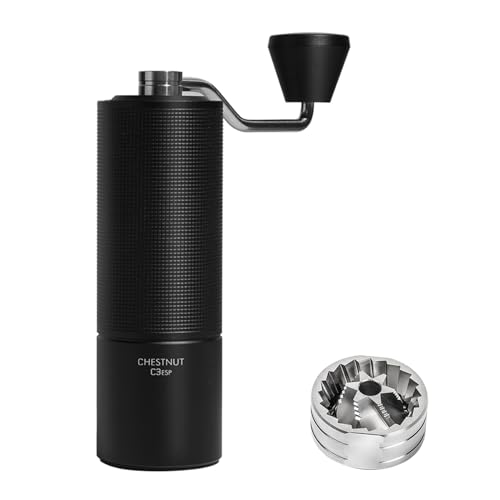
TIMEMORE Chestnut C3 ESP Manual Coffee Grinder
S2C conical burrs with an espresso-fine adjustment range, for about a third of the cheapest electric espresso grinder.
Check price
1Zpresso J-Ultra Manual Coffee Grinder
External numbered adjustment and a 40g catch cup, and it grinds an espresso dose in well under 30 seconds.
Check price
Baratza Encore ESP Coffee Grinder
The Encore body with espresso-capable burrs and 20 micro-adjustments inside the espresso range. Baratza publishes parts diagrams and sells every wear part, so it is repairable rather than disposable.
Best for: Pairing with a Bambino Plus or Gaggia Classic as a first proper setup.
Check priceBudget bands are a guide; confirm the current price on Amazon. As an Amazon Associate we earn from qualifying purchases.
How long does grinding an 18 g dose actually take?
Between roughly 30 and 70 seconds, and the spread inside that range is the single most useful thing to know before buying. Grind time is set by burr diameter, burr geometry, gear ratio, the roast level of the bean and how fine you are grinding.
Burr diameter dominates. A 48 mm burr set removes more coffee per rotation than a 38 mm one, so the 1Zpresso J-Ultra gets an 18 g espresso dose done in under 30 seconds while a 38 mm grinder such as the TIMEMORE Chestnut C3 ESP typically takes 50 to 70 seconds at the same fineness. That is a real difference at seven in the morning, and it is most of what the extra under $250 buys.
Roast level matters more than people expect. Dark roasted beans are brittle and porous and shatter easily, so they grind fast and take relatively little effort. Light roasted beans are dense and hard, and grinding them fine enough for espresso by hand is genuinely a workout. If you drink light roast single origins, weight your decision toward the larger burr set. If you drink medium-dark blends for milk drinks, the smaller grinder is far less punishing than its reputation.
The figures below are approximate rather than manufacturer specifications, drawn from published specifications and verified owner reports, because grind time varies with bean, setting and how hard you turn the handle. They are close enough to plan around and not precise enough to quote to two decimal places.
| Grinder | Burr material and size | Adjustment | Time to grind 18 g | Price |
|---|---|---|---|---|
| TIMEMORE Chestnut C3 ESP | S2C stainless steel conical, 38 mm | Stepped, espresso-fine increments | Roughly 50 to 70 seconds by hand | Under $100 |
| 1Zpresso J-Ultra | Stainless steel conical, 48 mm | External numbered dial, increments finer than 10 microns | Under 30 seconds by hand | Under $250 |
| Baratza Encore ESP (electric) | Steel conical, 40 mm | Stepped, 40 positions with 20 inside espresso | About 10 to 15 seconds, motorised | Under $250 |
| Breville Smart Grinder Pro (electric) | Conical steel, size not published | Stepped, 60 settings across the full range | About 10 to 15 seconds, motorised | Under $250 |
Sources: burr size, burr material and adjustment figures come from TIMEMORE, 1Zpresso and Baratza product specifications; grind times are the ranges reported consistently in verified owner reviews, not our own timing. Prices are Amazon list prices checked in 2026.
The last two rows are in the table on purpose. The Baratza Encore ESP and the Breville Smart Grinder Pro both cost under $250 and both do the same job in about 10 to 15 seconds with no effort at all. A page about hand grinders that hid those rows would be selling rather than advising.
What makes a hand grinder espresso-capable?
Three specifications, in this order of importance, and none of them is burr material.
Adjustment resolution comes first. Espresso lives in a narrow band, and a grinder whose clicks are too far apart cannot land a 25 to 30 second shot. It will give you 21 seconds or 34 seconds and nothing usable between. The J-Ultra solves this with an external numbered dial in increments finer than 10 microns, which is fine enough that a single click is a small change in shot time. The C3 ESP solves it by concentrating its adjustment range at the fine end where espresso lives, which is the right compromise at under $100.
Burr quality and geometry comes second. Conical burrs produce a wider bimodal particle distribution, which reads in the cup as body and tends to be forgiving of an imperfect puck. Every espresso-capable hand grinder uses conical burrs, because a flat set needs a motor to drive it properly. Hardened stainless steel holds an edge for years of home use, and the coating and cut pattern matter more than the alloy name printed on the box.
Axle stability comes third and is the specification nobody lists. At espresso settings the burr gap is very small, and the load on the shaft is high because you are cutting hard beans in a tight gap. A grinder with a single bearing and a thin shaft lets the inner burr wander off centre under that load, so half a rotation grinds finer than the other half. Double-bearing designs with a thick shaft are what separate an espresso hand grinder from a filter one, and they are the reason espresso models cost more than they appear to justify.
Retention is a footnote here rather than a specification. Hand grinders hold very little coffee because the path from burrs to catch cup is short and vertical, and a tap on the side clears most of what is left. That is one genuine advantage over cheap electric grinders, which often hold several grams in a long chute. If retention is your main concern, how to choose an espresso grinder works through when it matters and when it does not.
What do you give up against an electric grinder?
Time, consistency of effort, and the ability to grind while doing something else. Those sound minor written down and they are the whole argument in practice.
Time is the obvious one. Roughly a minute per dose against 12 seconds is a difference you feel on a weekday. It also changes the shape of the morning: an electric grinder runs while you heat the machine and rinse the basket, whereas a hand grinder is a minute where you can do nothing else.
Dose consistency is the subtler one. A timed electric grinder can be set to deliver roughly the same dose every time. A hand grinder gives you exactly what you put in, which is more accurate if you weigh beans first and less convenient if you do not. In practice that pushes hand grinder owners toward single dosing and weighing, which is a better habit anyway, but it is a habit rather than a feature.
Scale is the one that decides it. Two drinks a day is 730 doses a year, which at roughly a minute each is about 12 hours of cranking. That is fine. Four drinks a day doubles it, guests make it worse, and the grinder quietly becomes the reason you stop making espresso at home.
What you gain is worth stating too. No noise, which matters in a flat or an early morning house. No counter space, since it lives in a drawer. No electronics to fail. Full portability. And at the $68 to $199 level, better burrs than the electric grinder you would otherwise have bought.
Who is a hand grinder genuinely right for?
Four readers, and if you are not one of them the electric answer is probably better.
Small kitchens. If counter space is the binding constraint rather than budget, a grinder that lives in a drawer is not a compromise, it is the only option that fits. A Breville Bambino Plus at under $500 is 7.7 inches wide, and with a C3 ESP the whole setup totals under $1,000 and occupies less than eight inches of worktop. The beginner coffee bar setup prices a complete build around exactly that constraint.
Travel and offices. A hand grinder plus a manual lever such as the Flair 49 PRO makes genuine 9 bar espresso with no electricity anywhere in the chain. Nothing else in coffee does that, and it is why plenty of people own a hand grinder alongside a full electric setup at home.
One or two drinks a day. At that volume the effort never compounds into resentment, and the money saved is real: the C3 ESP is under $250 less than the Encore ESP, which covers a scale and a distribution tool with change left.
A second grinder for light roasts. This is the case people arrive at last. If your electric grinder is dialled in for a house espresso blend, re-dialling it for a bag of light roast and back again is tedious, and retention means the first dose after each switch is a blend. A hand grinder handles the occasional bag without touching the main setting at all.
Who should not buy the 1Zpresso J-Ultra?
Anyone making more than two drinks a day. The 1Zpresso J-Ultra at under $250 is an excellent grinder and the effort compounds in a way the specification sheet cannot show you. Four drinks a day is double the cranking, guests add more, and a Saturday morning for four people is roughly two minutes of grinding before anyone drinks anything. Grinders do not get abandoned because they grind badly. They get abandoned because using them became a chore.
The honest answer above roughly $200 is an electric grinder. The J-Ultra sits under $25 under the Baratza Encore ESP , which grinds the same dose in about 12 seconds, offers 20 micro-adjustments inside the espresso range, and has published parts diagrams so every wear component is replaceable. For another under $250 the Eureka Mignon Zero at under $500 adds stepless 55 mm flat burrs and near-zero retention, and for under $250 more the MiiCoffee DF64 II at under $500 adds 64 mm flat burrs. Those are the machines that actually raise the ceiling, and the grinders under $500 roundup covers that band in full.
Anyone who wants one grinder for espresso and pourover should think carefully too. Switching a hand grinder between the two is a known number of clicks and takes seconds, which is fine. Doing it four times a day is not. An electric grinder with numbered stepless adjustment and a bellows makes that switch trivial, and it is worth the money if your household genuinely brews both ways daily.
Anyone with wrist or grip problems should not be talked into this category at all. Grinding 18 g of light roast fine enough for espresso is real physical work against real resistance, repeated every day. That is a good reason to spend the same money on an electric grinder and never think about it again, and it is not a compromise on the coffee.
We also have full reviews of each: TIMEMORE Chestnut C3 ESP Pro review and 1Zpresso X-Ultra review.
Frequently asked questions
What is the best budget hand grinder for espresso?
The TIMEMORE Chestnut C3 ESP, under $100 on Amazon in 2026. It is one of the cheapest hand grinders built for espresso rather than adapted to it, with S2C conical burrs and a click range that reaches espresso-fine. Cheaper general purpose hand grinders usually cannot grind fine and consistent enough for a 25 to 30 second shot, so spending less tends to cost you more in wasted coffee.
What is the best hand grinder for espresso?
The TIMEMORE Chestnut C3 ESP at under $100. Its S2C conical burrs have an espresso-fine adjustment range, and at that price it out-grinds most electric grinders under $200 because none of the budget goes into a motor, a housing or a hopper. If you grind daily and want it over faster, the 1Zpresso J-Ultra at under $250 has 48 mm burrs, an external numbered dial and takes under 30 seconds per dose.
Can a hand grinder really grind fine enough for espresso?
Yes, if it was designed for it. Espresso-capable hand grinders have burr geometry cut for fine work, an adjustment mechanism with small increments and a stiff axle that does not flex under load. A general purpose hand grinder sold for French press usually cannot reach espresso fineness at all, or reaches it only at the end of its travel where the burrs chatter and the grind turns inconsistent.
How long does it take to grind 18 g by hand?
Between roughly 30 and 70 seconds depending on the grinder, the roast and the setting. The 1Zpresso J-Ultra with 48 mm burrs is at the fast end, under 30 seconds, while a 38 mm grinder such as the C3 ESP typically takes 50 to 70 seconds at espresso fineness. Dark roasts are brittle and grind quickly, and light roasts are dense and take noticeably longer.
Is a hand grinder better than an electric grinder at the same price?
Under about $200, usually yes on grind quality. A hand grinder spends nothing on a motor, a chassis or a hopper, so a much larger share of the price goes into burrs, adjustment resolution and axle stability. Over about $300 the comparison reverses completely, because electric grinders in that band offer stepless adjustment, near-zero retention and no effort at all per dose.
Do you need to adjust a hand grinder between espresso and pourover?
Yes, and it takes a few seconds. Espresso sits at the fine end and pourover several turns coarser, so the adjustment is a known number of clicks apart once you have found both. A hand grinder with an external numbered dial makes that trivial because you can write the two settings down. An internal dial without markings makes switching back and forth genuinely annoying.
Are hand grinders good for travel espresso?
They are the natural pairing. A manual espresso maker such as the Flair 49 PRO needs no power and neither does a hand grinder, so the whole setup works in a hotel room, an office or a campsite. The combination is also the only way to make genuine 9 bar espresso with no electricity at all, which is why hand grinders remain popular with people who already own an electric one at home.
How we choose: we compare published manufacturer specifications, verified owner reviews and published barista guidance. We do not test gear in person. Espresso machines run mains electricity, pressurised water and steam above boiling point, so follow your manufacturer's manual and leave electrical or boiler work to a qualified technician. Everything here is researched guidance, not professional advice.