Best Espresso Scales in 2026: 0.1 g, Timer and Drip Tray Fit
The Maestri House S2 at under $50 is the espresso scale most people should buy: 0.1 gram resolution, an auto-start timer, and a footprint small enough to sit on a drip tray under the portafilter. Espresso needs exactly four things from a scale, 0.1 g resolution, a timer, a small flat footprint and enough sealing to survive a wet bar, and capacity above about 2,000 g is irrelevant because a double shot weighs 36 g. Spending more buys live flow rate data, which is a diagnostic feature rather than a better measurement.
The Maestri House S2 at under $50 is the espresso scale most people should buy. It reads to 0.1 g, it starts its timer when liquid hits the cup, and it is small and flat enough to live on a drip tray under the portafilter. That is the entire specification for weighing espresso, and everything above this price buys diagnostics rather than better weighing.
What does an espresso scale need to do that a kitchen scale cannot?
An espresso scale is a small, fast, splash-tolerant scale with 0.1 gram resolution and a built-in shot timer, sized to sit on a drip tray underneath a portafilter while the shot runs. Every one of those words is a requirement, and a normal kitchen scale usually fails on three of them at once.
Start with size, because that is the requirement people discover last and resent most. The gap between the bottom of a portafilter spout and the drip tray is small on almost every home machine. A scale with a raised bowl, a thick base or a wide platform simply does not fit, and if it half fits you end up balancing a cup on a scale that is balanced on a tray, which is how people knock a full shot across a counter. A flat rectangular scale with a low profile and a footprint close to the tray dimension is not a nice feature. It is what makes weighing the shot possible at all.
Then speed. Espresso runs for 25 to 30 seconds and the interesting part is the first eight. A scale that updates twice a second shows you a number that is always slightly behind the cup, so you stop the pump late and overshoot the yield. Coffee scales are built with faster refresh rates and lighter filtering than kitchen scales for exactly this reason. Kitchen scales do the opposite on purpose: they damp the reading heavily so that a wobbling mixing bowl shows a stable number.
Then the timer. A shot has three variables you can record without any extra equipment: dose in, yield out and time. A scale with an integrated timer captures two of them on one display and removes the phone-in-one-hand routine entirely. An auto-start timer that triggers when weight starts climbing is better still, because it starts at first drip rather than at the moment you remembered to tap the screen.
Then water. A bar is a wet environment: steam, drips, a purge before the shot, a rinse of the basket. Nothing in this price band is submersible, and nothing needs to be. What matters is a sealed top surface with no seam for liquid to run into and a charging port you can keep away from the machine. Water under a load cell is what kills cheap coffee scales, not the weighing electronics.
Capacity is the one specification nobody needs to think about. A double espresso weighs 36 g and a cup weighs maybe 120 g. Anything above roughly 2,000 g is marketing. A 5,000 g kitchen scale is not more capable for espresso, and in practice a high capacity load cell is a reason a scale reads coarsely at the low end, which is exactly where espresso lives.
Espresso scales by tier

Maestri House S2 Espresso Coffee Scale with Timer
0.1 gram resolution, an auto-start timer and a footprint that fits a drip tray. That is the whole requirement for weighing a shot.
Best for: A first scale, bought at the same time as the machine rather than a year later.
Check price
TIMEMORE Black Mirror Basic 3 Coffee Scale with Timer
Fast enough for espresso and large enough for a pourover server, with a flat glass top that wipes clean.
Best for: One scale that covers espresso, filter and kitchen use.
Check price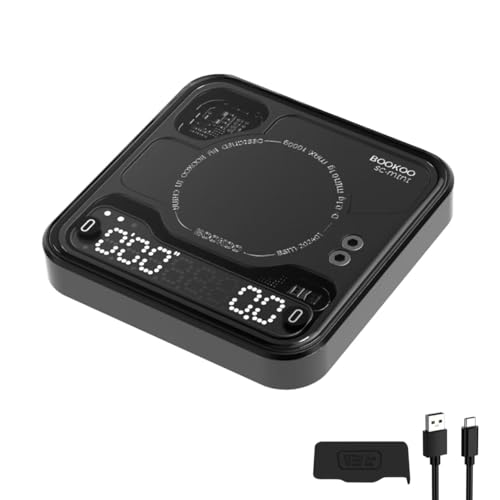
BOOKOO Coffee Scale with Timer and Flow Rate
Live flow rate in grams per second, which is the number that tells you a shot is channelling while it is still running rather than afterwards.
Best for: Diagnosing extraction problems, not just recording them.
Check priceBudget bands are a guide; confirm the current price on Amazon. As an Amazon Associate we earn from qualifying purchases.
Why weigh a shot at all?
Because volume in a cup is mostly crema, and crema is gas. Two shots can fill a demitasse to the same line and weigh 28 g and 41 g, because one was pulled on a fresh dark roast that foamed and the other on a two month old bag that barely fizzed. Judging a shot by the level in the cup means judging it by how much carbon dioxide the beans happened to be carrying that week.
That matters because a shot that looks right and a shot that weighs right are different shots. The brew ratio, yield divided by dose, is the number that determines strength and much of the balance. An 18 g dose yielding 36 g is a conventional 1:2 double at a ratio of 2.00. Stopping by eye at the same visual level might have been 30 g, which is a ristretto, or 48 g, which is heading toward lungo. Those are three different drinks, and none of them is wrong, but you cannot choose between them if you cannot see the number.
The deeper reason is repeatability. Without a scale you cannot reproduce yesterday, which means every change you make is measured against a baseline you did not record. Grind finer, and the shot tastes different: was it the grind, or was it the 1.7 g of extra dose you happened to put in? Dialling in is a process of changing one variable and reading the result, and it collapses entirely if the other variables are drifting unrecorded. The how to dial in espresso guide walks through that loop, and every step in it assumes you know your dose and your yield to a tenth of a gram.
If you want to see how much the ratio moves for a given dose and yield before you buy anything, the espresso dose and yield calculator and the brew ratio calculator both run the arithmetic. They are also the quickest way to understand why a tenth of a gram on the dose is worth more attention than a tenth of a gram in the cup.
Does 0.1 gram really matter?
On the dose, yes, and it is easy to show with numbers rather than adjectives. Take a fixed 36 g yield. At 18.0 g in, the ratio is 2.00. Half a gram light, at 17.5 g, the ratio is 2.06. Half a gram heavy, at 18.5 g, it is 1.95. That is the full spread a 1 gram scale can hide inside a single reading of "18", because a scale that displays whole grams rounds everything from 17.5 to 18.4 to the same number.
A half gram swing on the dose also changes the puck depth, which changes headspace, which changes how the water hits the bed. That is the part people underestimate. Dose is not only a ratio input, it is a physical fit inside the basket, and an 18 g basket run at 16 g leaves a gap the puck expands into unevenly. At 16 g against a 36 g yield the ratio is 2.25, a lungo you did not order, pulled through a puck that is now too shallow for the basket it is in.
On the yield the stakes are genuinely lower. The difference between 36.0 g and 36.4 g in the cup is not something anyone tastes reliably. This is why a scale that reads to 0.1 g but takes a moment to settle is still perfectly good for espresso: you use the precision where it counts, on the dose you weigh at leisure, and you use the speed where it counts, on the yield you are watching climb.
One honest caveat about cheap scales at this resolution. Displaying 0.1 g and being accurate to 0.1 g are different claims, and manufacturers in this band rarely publish a linearity specification. What a $32 scale reliably gives you is good repeatability: it may read your 18.0 g as 18.1 g, but it will read the same coffee the same way every morning. For dialling in, repeatability is what you actually need, because you are comparing today to yesterday on the same instrument rather than comparing your kitchen to a laboratory.
| Scale | Resolution | Capacity | Timer | Auto-start | Water resistance | Price |
|---|---|---|---|---|---|---|
| Maestri House S2 | 0.1 g | 3,000 g | Yes, built in | Yes, flow triggered | Splash resistant top, not submersible | Under $50 |
| TIMEMORE Black Mirror Basic 3 | 0.1 g | 2,000 g | Yes, built in | Yes, espresso mode | Sealed glass top, not submersible | Under $100 |
| BOOKOO Coffee Scale | 0.1 g | 2,000 g | Yes, plus live flow rate | Yes, flow triggered | Not published | Under $250 |
| Acaia Lunar (benchmark) | 0.1 g | 1,000 g | Yes, plus flow rate in app | Yes, multiple brewing modes | Water resistant, designed for a drip tray | Not published |
| Typical kitchen scale | 1 g | 5,000 g | No | No | Not published | Around under $25 |
The kitchen scale row is in the table on purpose. Read across it and the case for a dedicated scale is not about accuracy at all: it is 1 g resolution, no timer, no auto-start and a footprint that will not fit under a portafilter. Three of those four are geometry and workflow problems, which is why people who already own a decent kitchen scale still end up buying one of these.
The Acaia Lunar is the benchmark row. It is the scale most cafes put in the drip tray, it is water resistant by design, and its refresh rate and flow rate reporting are the reference other scales are measured against. It carries a search link here rather than a direct product link, because it is sold mainly through specialty coffee retailers and is not reliably stocked as a single Amazon listing. A search link is the honest answer when a product genuinely is not there.
Do you need flow rate and auto-tare?
Auto-tare and auto-start are convenience features that pay for themselves immediately. Auto-tare zeroes the scale when you set a cup on it, and auto-start begins the timer at first drip. What they remove is the sequence of taps that always seems to go wrong at seven in the morning: place cup, tare, start timer, start pump, realise the timer never started. Every scale on this page has both, so it is not a differentiator, but it is the reason a $32 coffee scale beats a $15 kitchen scale for this job.
Flow rate is a different kind of feature. It shows live grams per second as the shot runs, and the shape of that number over 30 seconds is a picture of the extraction. A healthy shot ramps up and then holds roughly steady. A channelling shot accelerates part way through as water finds a path of least resistance and the puck stops resisting. Reading that on the scale tells you the shot failed while it is still running, rather than telling you afterwards when the cup tastes thin and sour.
That is genuinely useful, and it is also genuinely a specialist feature. The BOOKOO at under $250 is under $100 more than the Maestri House S2 , and every cent of that is buying diagnostic capability rather than a better number. If your shots are already landing in 25 to 30 seconds most mornings and you want to understand the ones that do not, that money is well spent. If your shots are landing anywhere between 15 and 45 seconds, flow rate will simply give you a detailed picture of a problem you already know you have.
The TIMEMORE Black Mirror Basic 3 at under $100 sits between them for a different reason. It is under $50 more than the Maestri House and under $100 less than the BOOKOO, and what it buys is versatility: a flat sealed glass top that wipes clean, and enough platform to hold a pourover server. If you brew filter as well as espresso and want one scale on the bar rather than two, that is the one to buy.
Where does the scale actually sit?
Two places, and they have different requirements, which is the argument some people use for owning two scales.
The first is next to the grinder, holding a dosing cup while you weigh beans in. Nothing about that position is demanding: it is dry, it is flat and it has all the headroom in the world. Any 0.1 g scale does this job, including a kitchen scale.
The second is on the drip tray, under the portafilter, holding the cup while the shot runs. That position is wet, cramped and hot, and it is the one that decides the purchase. Measure the clearance on your machine before you buy anything: the vertical gap from the spouts to the tray, and the flat area of the tray itself. A scale that is 20 mm thick with a 3 oz demitasse on top of it needs to leave enough room that the portafilter still locks in.
Bottomless portafilters make the geometry easier, because there are no spouts hanging down, and the shot falls further into the cup. Machines with a tall body and a low tray, which includes most compact machines, make it harder. If your machine simply will not take a scale under the portafilter, the workable compromise is to weigh the dose in, weigh the empty cup, and weigh the full cup afterwards. You lose the live yield reading but you keep the ratio, which is most of the value.
Space on the bar as a whole is worth planning at the same time. The counter space planner lays out machine, grinder, knock box and scale against your actual worktop, and the coffee bar setups pages show where the scale sits in a build that already works.
Is a $129 scale better than a $32 one, and at what?
At diagnosis, yes. At weighing, not meaningfully. Both read to 0.1 g, both have a timer, both auto-start. The expensive one adds live flow rate, app connectivity and a more refined build. None of that changes what the scale reports about your dose or your yield, and none of it makes a shot taste better on its own.
This is worth saying plainly because the scale category invites the opposite assumption. In most espresso gear the price ladder correlates with capability: a $549 grinder genuinely produces a better particle distribution than a $199 one, and a $1,600 dual boiler genuinely holds temperature better than a $299 single boiler. Scales do not work like that. A scale is a measuring instrument sitting outside the brewing process, and past the four requirements at the top of this page, more money buys you a nicer instrument rather than a better cup.
The practical consequence is that the scale line in a build budget should be small and settled early. Buy a competent one at the same time as the machine, not a year later after a hundred unrepeatable shots, and put the rest of the money where it changes the coffee.
Who should not buy the BOOKOO?
Anyone who does not yet own a grinder that can hold a shot time steady. Flow rate is a measurement of how the puck resists water over 30 seconds. If your grinder cannot deliver the same particle distribution twice in a row, the flow rate curve is telling you about the grinder, not about your technique, and you will spend weeks reading a graph whose message is always the same: buy a better grinder.
The test is simple. Pull three shots on the same setting, same dose, same puck prep, and note the time each takes to reach 36 g. If they land within a couple of seconds of each other, your grinder is repeatable and flow rate data will tell you something real about the shots that go wrong. If they scatter across ten seconds, the variable that is moving is the grind, and the Baratza Encore ESP at under $250 or better is the purchase that fixes it.
Anyone who only ever pulls one recipe should also skip the expert tier. If you drink one bean, at one dose, into milk, every morning, you need a scale that tells you the dose and the yield and then gets out of the way. That is an under-$50 problem. Buying diagnostics for a workflow with nothing to diagnose is the definition of an accessory that does not earn its place on the counter.
And anyone whose budget is still open should think about the order of purchases. under $100 is not a lot of money in isolation, and it is a meaningful fraction of the gap between a competent grinder and a good one. That is the trade this page keeps coming back to, and it is the one worth getting right.
We also have a full BOOKOO espresso scale review.
Frequently asked questions
What is the best espresso scale?
The Maestri House S2 at under $50 for most people. It has 0.1 g resolution, an auto-start timer and a footprint that fits under a portafilter on a drip tray, which is the entire requirement for weighing a shot. The TIMEMORE Black Mirror Basic 3 at under $100 is the better single scale if you also brew filter coffee, because it is large enough to sit under a pourover server.
Do you really need 0.1 gram resolution for espresso?
For the dose, yes. A 1 g scale can read an 18.0 g dose as anything from 17.5 to 18.4 g, and that error alone moves a 1:2 ratio to roughly 1:2.06 or 1:1.95 without you touching anything. For the yield in the cup the stakes are lower, because 36 g against 36.4 g is a small change. Buy the resolution for the dose and enjoy it on the yield.
Can you use a kitchen scale for espresso?
For weighing beans into the grinder, yes, if it reads to 0.1 g. For weighing the shot in the cup, usually not: most kitchen scales are too tall and too wide to sit on a drip tray under a portafilter, have no timer, and update too slowly to show a shot developing. The scale problem in espresso is a size and speed problem at least as much as an accuracy one.
What is flow rate on a coffee scale and does it matter?
Flow rate is the live weight gain in grams per second during the shot. It matters because a channelling shot speeds up mid-extraction, and the flow rate number shows that while the shot is still running rather than after you taste it. It is a diagnostic feature. It is worth paying for once your grinder can hold a shot time steady, and largely wasted before then.
Will an espresso scale survive sitting in a wet drip tray?
Sealed-top scales cope with splashes and steam, and none of the scales in this price band is submersible. The practical routine is to wipe the top after every shot, never rinse the scale under a tap, and keep the charging port away from the machine. Water in the port or under the load cell is the failure mode that kills cheap coffee scales, not the weighing electronics themselves.
Should you buy a better scale or a better grinder first?
The grinder, without much hesitation. A scale is a measuring instrument: it reports the dose, the yield and the time but changes none of them. The grinder is the control that actually alters extraction. Moving under $100 from the scale line to the grinder line is one of the highest value swaps in a home setup, because it improves every shot rather than merely describing them more precisely.
How we choose: we compare published manufacturer specifications, verified owner reviews and published barista guidance. We do not test gear in person. Espresso machines run mains electricity, pressurised water and steam above boiling point, so follow your manufacturer's manual and leave electrical or boiler work to a qualified technician. Everything here is researched guidance, not professional advice.