Best Milk Frother in 2026: Microfoam, Hot Foam, Plant Milk
The Subminimal NanoFoamer Lithium at under $50 is the milk frother most people should buy, because its micro-mesh screens shear air into bubbles small enough to pour as microfoam rather than as foam sitting on milk. Texture milk to 55 to 65 C, which is 130 to 150 F, because lactose sweetness peaks near 60 C and above roughly 70 C the proteins denature and the milk tastes scalded. If your machine already has a real steam wand you should skip this category entirely and spend under $25 on a 12 oz pitcher instead.
The Subminimal NanoFoamer Lithium at under $50 is the milk frother most people should buy. Its interchangeable micro-mesh screens force air into milk at a scale a whisk cannot reach, which is the difference between foam that sits on top of your drink and foam that pours through it. It is the right answer for a machine with no steam wand, and for a super-automatic whose froth comes out too airy to work with.
What is a milk frother actually for?
A milk frother is a device that beats air into milk to produce foam, and the good ones aim at microfoam: milk aerated into bubbles too small to see individually, so it pours as one glossy liquid rather than as foam sitting on top of milk. That definition is the whole category in one sentence, and the word doing the work is "microfoam".
Think about what you actually want in the cup. A cappuccino or a latte is not espresso with a lid of bubbles on it. It is espresso combined with milk whose texture has changed: thicker, sweeter, glossy, and homogeneous enough that the first sip and the last sip are the same drink. When milk is properly textured you can pour it and it moves as one substance. When it is merely frothed you get two layers, a dry crust you have to spoon off and thin hot milk underneath, and the drink separates in the cup within a minute.
The physical difference between the two is bubble size and nothing else. Big bubbles are unstable, they rise, coalesce and pop, and they trap a dry cap of air on the surface. Very small bubbles are stable, they stay suspended in the liquid, and they make the milk behave like paint. Every design decision in this category is an attempt to make the bubbles smaller.
That is where the honest ranking comes from. A handheld frother approximates microfoam, and a steam wand produces it. The reason is not brand quality or price. A steam wand injects pressurised steam below the surface, which heats the milk and aerates it at the same time while the jet spins the entire volume in the pitcher. That rolling motion is what shears large bubbles into small ones and folds them evenly through the milk. A device that spins a screen in a jug of already-hot milk is doing a fair imitation of the second half of that process without the first half at all.
A NanoFoamer gets closer than a whisk because of how it aerates. A coiled whisk beats air into the surface, which is a coarse process producing visible bubbles. A NanoFoamer pushes milk through a fine mesh at speed, and the mesh shears the incoming air into far smaller bubbles before they have a chance to combine. It is a genuinely better mechanism, not a marketing story, and it is why one under $50 device is worth recommending in a category full of $12 wands that all do the same coarse thing.
Milk frothers by tier

Subminimal NanoFoamer Lithium Milk Foamer
Interchangeable micro-mesh screens force air into milk at a scale a whisk cannot reach, so it produces pourable microfoam rather than dry bubbles.
Best for: A machine with no steam wand, or a super-automatic whose froth is too airy.
Check price
Breville BMF600XL Milk Cafe Milk Frother
An induction jug with a temperature dial and two discs, one for latte and one for cappuccino. It heats and textures without your attention.
Best for: Making several milk drinks at once, or hot chocolate for people who do not drink coffee.
Check price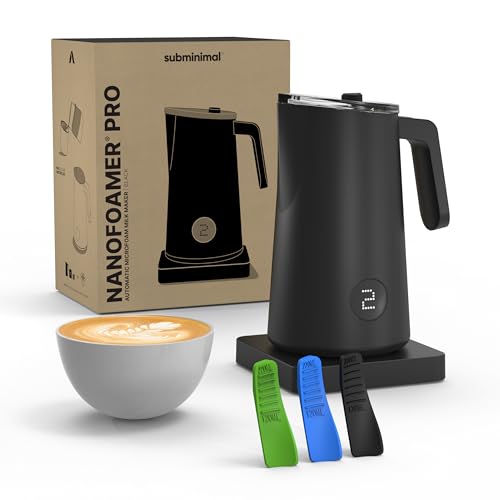
Subminimal NanoFoamer Pro Gen-2 Milk Foamer
A hands-free stand version with programmable texture and temperature, aimed at latte art rather than at merely hot foam.
Best for: Latte art practice on a machine whose steam wand is underpowered.
Check priceBudget bands are a guide; confirm the current price on Amazon. As an Amazon Associate we earn from qualifying purchases.
You will have noticed that the Expert tier costs less than the Intermediate one. The NanoFoamer Pro Gen-2 at under $250 is under $50 cheaper than the Breville Milk Cafe at under $250, and that ordering is correct rather than a mistake. These are not two rungs of one ladder. The Milk Cafe is an automatic jug that heats and textures the milk unattended: you pour milk in, set a dial, walk away and come back to hot foam, and it will make hot chocolate for people who do not drink coffee. The NanoFoamer Pro is a manual tool with programmable texture on a hands-free stand, aimed squarely at someone chasing pourable microfoam for latte art. Different jobs. One is about removing your attention from the process, the other is about applying more of it.
Price the two by what they replace and the logic is clear. If your goal is a milk drink with no effort, the extra under $50 buys automation. If your goal is a rosetta on top of a flat white, the automation is worthless and the under $250 between the Lithium and the Pro buys repeatability in texture. Someone who wants both is describing a steam wand.
Do you need a frother if your machine has a steam wand?
Mostly no, and this is the most useful paragraph on the page for anyone who arrived here already owning an espresso machine.
A real steam wand outperforms everything in this category. It heats and aerates simultaneously, it works on any volume you can fit in the pitcher, it takes about twenty seconds, and it is already attached to the machine you paid for. Buying an under-$50 frother to use next to a working steam wand is buying a slower way to get a worse result. If your wand texture is disappointing, the answer is almost always technique rather than hardware, and the steaming milk and latte art guide covers the two things people get wrong: how long to keep the tip at the surface introducing air, and how to position it so the milk spins rather than churns.
There are two honest exceptions. The first is a panarello sleeve, the perforated plastic tube fitted over the wand on many entry machines. A panarello drags in air automatically and produces a stiff, dry, bubbly foam that is very hard to pour with. It is designed to make foam without skill, and it succeeds at exactly that and nothing more. If your machine has one and cannot be fitted with a bare wand, a NanoFoamer genuinely will give you better texture.
The second is a super-automatic with an automatic milk system. Those systems vary enormously. Some produce respectable texture, and some produce an airy froth that is fine in a cappuccino and useless in a flat white. A Philips 3200 LatteGo at under $500 is a good example of the trade the whole category makes: the milk carafe is two parts with no tubes, which solves the cleaning problem that makes people abandon super-automatics, and the texture is a compromise made in service of that.
If neither exception applies to you, close this page and go practise. The milk temperature chart will do more for your drinks than anything you could buy here.
What is the difference between a whisk frother, an automatic jug and a NanoFoamer?
They differ on two axes: whether the device heats the milk, and how finely it aerates it. Almost every purchasing mistake in this category comes from ignoring the first axis.
A handheld whisk frother does not heat. You warm the milk separately, usually in a microwave, and then whisk it. Aeration is coarse, the foam is visibly bubbly, and it collapses quickly. These cost very little and they are honest about what they are: a way to put a foam hat on a coffee.
A NanoFoamer also does not heat. That surprises people, and it is worth knowing before you order, because it means the workflow is warm the milk, then texture it, in two steps with two vessels. What it buys in exchange is the mesh: air sheared fine enough that the milk pours rather than sits. The NanoFoamer Lithium is cordless and rechargeable, which matters more than it sounds when the alternative is a wired device on a wet bar.
An automatic jug like the Milk Cafe does both. An induction base heats the jug to a temperature you set on a dial while a magnetic disc spins inside, and it stops on its own. Two discs are supplied, one for latte texture and one for the drier cappuccino foam. The value here is unattended operation: it runs while you pull the shot, and it is genuinely the best answer for a household making several milk drinks at once or for a child who wants hot chocolate.
A steam wand does both, faster, and better. It is in the table below as the reference point because leaving it out would make every other row look better than it is.
| Device | How it heats | How it aerates | Capacity | Works with plant milk | Price |
|---|---|---|---|---|---|
| Subminimal NanoFoamer Lithium | Does not heat, you warm the milk first | Micro-mesh screens on a spinning shaft | Not published, used in your own jug | Yes, results vary by brand | Under $50 |
| Breville Milk Cafe | Induction base with a temperature dial | Whisk disc, latte or cappuccino | Not published | Yes, use a barista formulation | Under $250 |
| Subminimal NanoFoamer Pro Gen-2 | Does not heat, you warm the milk first | Programmable texture on a hands-free stand | Not published, used in your own jug | Yes, results vary by brand | Under $250 |
| Steam wand plus a 12 oz pitcher | Injected steam heats the milk directly | Air drawn in at the surface, then rolled in | 12 oz pitcher, one 6 oz latte | Yes, barista formulations texture best | Under $25 for the pitcher |
| Handheld whisk frother | Does not heat | Coiled whisk beating air into the surface | Not published | Yes, but foam collapses quickly | Not published |
Sources: frother specifications from Subminimal and Breville product pages; the 55 to 65 C milk temperature range follows published barista guidance such as the Specialty Coffee Association's. Prices are Amazon list prices checked in 2026. Researched, not tested in person.
Capacity is marked "Not published" in several rows on purpose. Manufacturers in this category are inconsistent about publishing usable jug volumes, and the NanoFoamer models are used inside whatever pitcher you already own, which makes a single capacity figure meaningless. The one number worth planning around is the 12 oz pitcher, which is the correct size for a single 6 oz latte and is the row that costs under $25.
What about oat and almond milk?
Foam is built from protein and stabilised by fat, and plant milks have different amounts of both than dairy does, which is the entire reason results vary so much between cartons.
Oat milk is the best of the plant options and textures genuinely well, particularly the formulations sold as barista editions, which add a small amount of fat and stabilisers specifically so the foam holds instead of collapsing. Buy those rather than the standard carton if milk drinks are the point. The texture you get is slightly heavier than dairy and pours cleanly enough for latte art.
Almond milk is harder. It carries less protein, so there is less structure holding the bubbles together, and it can split when it gets hot, producing a curdled look that does not come back. Soy sits in between and behaves reasonably in barista formulations. Coconut foams into large bubbles that collapse fast.
Across all of them the practical rule is the same and it is about heat. Plant milks scorch and separate more readily than dairy and rarely recover once they do, so aim at the lower end of the temperature window rather than the upper end. A drink at 55 C made from oat milk is better than one at 68 C, and the margin for error is smaller than with dairy.
What temperature should milk reach?
Texture milk to 55 to 65 C, which is 130 to 150 F. That is the window, and it is narrower than most people assume.
The reason to stop there is flavour. Lactose sweetness peaks near 60 C, so milk stopped around there tastes noticeably sweeter than the same milk taken hotter. Heat is doing something real to the sugar perception, and it is the cheapest improvement available in a milk drink: no equipment, just stopping earlier.
The reason not to go past it is chemistry. Above roughly 70 C, which is 158 F, the whey proteins denature. The milk develops the scalded, faintly eggy flavour that people associate with a bad cafe latte, and the texture goes thin because the protein structure holding the microfoam together has been broken. Milk taken to boiling is ruined in both dimensions at once, and no amount of good espresso underneath rescues it.
Judging this by hand on the side of the pitcher works, and it takes weeks to learn. A CDN clip-on frothing thermometer at under $25 works on the first morning. It clips to the pitcher rim and shows you exactly where the window is, and after a month of using it you will know the temperature by feel and can put it in a drawer. That is under $25 well spent regardless of which device you own, including a steam wand.
Who should not buy any of these?
Anyone whose machine already has a real steam wand. If you own a Bambino Plus, a Barista Express, a Gaggia Classic Evo Pro or anything with a bare articulating wand, the device that makes the best milk in your kitchen is already bolted to your espresso machine. Spending under $50 to under $250 next to it buys a slower route to a worse result.
What to buy instead costs under $50 in total: a De'Longhi 12 oz milk frothing jug at under $25 and the clip-on thermometer at under $25. The pitcher size matters more than the brand. A 12 oz jug is the right vessel for one 6 oz latte, and a larger pitcher makes texturing a single drink harder rather than easier, because there is not enough milk in it for the steam jet to set the whole volume spinning. That single mismatch, a big pitcher and a small drink, is the most common reason home steam wand texture disappoints.
The saving is not trivial either. The starter pair is under $250 less than the Milk Cafe, and that difference is most of the gap between two real espresso machines rather than a rounding error on an accessory.
Anyone buying a frother as a substitute for espresso should also stop. A latte is espresso plus textured milk. A frother makes the milk half and has nothing to say about the other half, so a frother next to a drip machine produces a milky coffee rather than a latte. That is a perfectly nice drink and it is not what you were shopping for.
Frequently asked questions
What is the best milk frother?
The Subminimal NanoFoamer Lithium at under $50 for most people. Its interchangeable micro-mesh screens force air into milk at a much finer scale than a whisk, so it produces something close to pourable microfoam rather than a raft of dry bubbles. If you want the whole job done unattended, the Breville Milk Cafe at under $250 heats and textures in one jug while you do something else.
Do you need a milk frother if your machine has a steam wand?
Mostly no. A steam wand injects pressurised steam that heats and aerates at the same time while spinning the whole volume, which is exactly what makes microfoam. A separate frother is a step backwards from that. The exception is a machine with a panarello sleeve, which produces airy foam rather than texture, and some super-automatic frothing systems whose output is too bubbly to pour.
What temperature should steamed milk be?
Between 55 and 65 C, which is 130 to 150 F. Lactose sweetness peaks around 60 C, so milk stopped there tastes noticeably sweeter than milk taken higher. Above roughly 70 C, which is 158 F, the whey proteins denature and the milk develops the scalded, slightly eggy flavour people associate with coffee shop milk drinks gone wrong. An under $25 clip thermometer removes the guesswork on day one.
What is the difference between a whisk frother and a NanoFoamer?
Bubble size. A coiled whisk beats air into the surface and produces visible bubbles that sit on top of the milk and collapse within a minute. A NanoFoamer pushes milk through a fine mesh screen, which shears the air into bubbles too small to see individually. That is the physical difference between foam floating on milk and microfoam, which pours as a single glossy liquid.
What is the best milk frother for hot milk and thick foam?
The Breville Milk Cafe, under $250, because it heats and froths in one jug: pour in cold milk, pick a temperature and a disc for latte or cappuccino foam, and it runs unattended. Handheld NanoFoamers make finer microfoam but do not heat, so you warm the milk first. For thick cappuccino foam on hot milk with no effort, the Milk Cafe is the better tool.
Which milk frothers are dishwasher safe?
Heated jug frothers are the easy ones: Breville lists the Milk Cafe jug as dishwasher safe, with the base kept dry. Handheld frothers such as the NanoFoamer have a motor in the handle, so only the removable screens or tips should be washed, and the handle is wiped. Check the manual for your exact model before putting any part in the dishwasher.
Can you froth oat milk and almond milk?
Oat milk textures well, especially barista formulations, which add a little fat and stabilisers so the foam holds instead of collapsing. Almond milk is harder because it has less protein and can separate when it gets hot. Whatever the milk, keep the temperature lower rather than higher, since plant milks scorch and split more readily than dairy and rarely recover once they do.
Is a milk frother enough to make a latte at home?
It makes the milk half of one. A latte is espresso plus textured milk, and a frother does nothing about the espresso. Paired with a moka pot or a strong filter brew you get a milk coffee that is pleasant but not a latte, because the concentrated base is missing. If lattes are the goal, the espresso machine is the purchase that matters and the milk device follows from it.
How we choose: we compare published manufacturer specifications, verified owner reviews and published barista guidance. We do not test gear in person. Espresso machines run mains electricity, pressurised water and steam above boiling point, so follow your manufacturer's manual and leave electrical or boiler work to a qualified technician. Everything here is researched guidance, not professional advice.