Breville Barista Express vs Barista Pro: Is the Faster Heater Worth It?
For most buyers the Breville Barista Express at under $1,000 is the better machine, because its analogue pressure gauge teaches grind adjustment in a way the Barista Pro's digital display does not, and the under-$250 saved buys under $250 of scale, distribution tool, water filter and cleaning kit that change the cup more than a faster heater does. Buy the Barista Pro at under $1,000 if a three second warm-up rather than a several minute one is what decides whether you use the machine on a weekday.
The Breville Barista Express at Under $1,000 and the Barista Pro at Under $1,000 are the same machine in almost every respect that touches the coffee: a built-in conical burr grinder, a 54 mm portafilter, PID temperature control, a steam wand and a single heating circuit. The price difference between them buys exactly two changes, and only one of them is unambiguously an upgrade.
What are the only two differences between the Barista Express and Barista Pro?
A one-box espresso machine is one that grinds, doses and brews from a single appliance, so there is no separate grinder to buy, house or plug in. Both machines are that, and the two things separating them are the heating system and the front panel.
The Barista Express uses a thermocoil, which is a coil cast into a heated block. It carries more thermal mass than a bare thermoblock, which makes temperature steadier across a long shot, and it takes minutes rather than seconds to be genuinely ready. On the front it has an analogue pressure gauge.
The Barista Pro uses a Thermojet, Breville's fast-heating variant, which reaches brew temperature in about three seconds. On the front it has a digital display showing shot time and the current mode instead of the gauge. That is the entire list. Same grinder class, same 54 mm basket, same PID, same wait between brewing and steaming.
| Specification | Barista Express | Barista Pro |
|---|---|---|
| Price | Under $1,000 | Under $1,000 |
| Heating system | Thermocoil | Thermojet |
| Quoted heat-up | Minutes, not seconds | About 3 seconds |
| PID temperature control | Yes | Yes |
| Front readout | Analogue pressure gauge | Digital display with shot timer |
| Portafilter size | 54 mm | 54 mm |
| Built-in grinder | Conical burr | Conical burr |
| Simultaneous brew and steam | No | No |
| Water tank | 67 oz | Not published |
| Price band | $600 to $1,000 | $600 to $1,000 |
Published specifications for each are on the Barista Express page and the Barista Pro page.
The two machines

Breville BES870XL Barista Express Espresso Machine
The default recommendation for a decade because it is a complete setup in one box: conical burr grinder, 54mm portafilter, steam wand and a 67 oz tank.
Best for: One purchase, one footprint, no separate grinder to buy or house.
Check price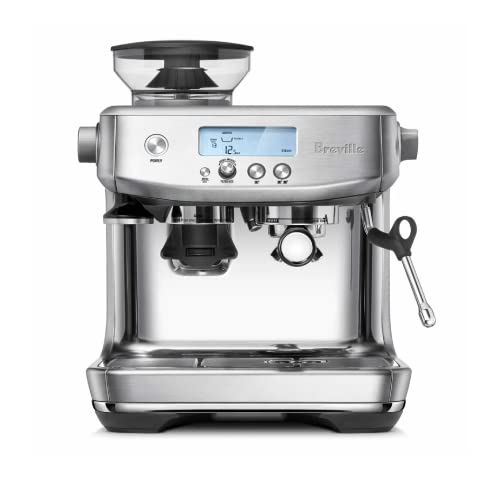
Breville BES878BSS Barista Pro Espresso Machine
The Barista Express with a thermojet heater and a digital display, so it is ready in seconds rather than minutes.
Check priceBudget bands are a guide; confirm the current price on Amazon. As an Amazon Associate we earn from qualifying purchases.
How much does the Thermojet actually change your morning?
More than the specification sheet suggests, and in one specific way: it changes whether the machine is a weekday machine. A heater that is ready in about three seconds is warm before you have finished weighing your dose. A thermocoil asks you to switch it on, do something else, and come back, and pulling the first shot into a cold group and a cold portafilter is one of the most common reasons that shot tastes thin and sour.
The Thermojet also shortens the transition between brewing and steaming, because there is less metal to bring from brew temperature up to steam temperature. Neither machine does both at once, so you still work in sequence, but the sequence is shorter on the Pro.
There is a cost, and it is worth naming: thermal reserve. A Thermojet stores very little hot water, so a run of four or five drinks leans harder on the control system keeping up, while the thermocoil's extra mass gives it a buffer. For one or two drinks a morning, which is what almost every home machine actually does, that buffer never gets tested. For a household making five, neither machine is really the right answer.
The cheap workaround on the Barista Express is a plug timer. Set it to switch on twenty minutes before your alarm and the speed advantage of the Pro largely disappears, at a small extra cost and some standby power.
Is the digital display an upgrade over the pressure gauge?
This is where the Barista Pro is arguably a downgrade, and it is the least discussed part of the comparison.
The gauge on the Barista Express shows the pressure the puck is generating while the shot runs. A grind that is too coarse lets water through easily and the needle sits low. A grind that is too fine chokes the puck and the needle pins high. That is a live physical readout of the single variable beginners struggle with most, and it converts grind adjustment from guesswork into a feedback loop within a week.
The Barista Pro display gives you shot time and mode. Shot time is genuinely useful, but it is also information any scale with a timer already gives you for under $50, and the scale gives you the yield in grams at the same time, which the display does not. So the Pro removes a piece of information you cannot get elsewhere and adds one you can.
None of that matters once you are dialled in and grinding the same bean every day. It matters a lot in the first two months. If you are buying your first real espresso machine, that is an argument for the Express.
What else does the price difference buy for the same machine?
Rather than the faster heater, the same money buys the accessories that actually change what comes out of a 54 mm basket. Every item below fits either machine.
| Instead of the Barista Pro premium | Price | Running total |
|---|---|---|
| Normcore WDT distribution tool V3 | Under $50 | Under $50 |
| Maestri House S2 espresso scale | Under $50 | Under $100 |
| Breville Knock Box 10 | Under $50 | Under $100 |
| Breville Claro Swiss water filter, 2 pack | Under $25 | Under $250 |
| Breville espresso cleaning tablets, 8 pack | Under $25 | Under $250 |
| Normcore tamping mat | Under $25 | Under $250 |
That is Under $250 of kit with Under $50 still in hand against the full price difference. The WDT distribution tool alone is the largest improvement per dollar in espresso, because it breaks up the clumps a grinder throws into the basket and clumps are where channels start. The Claro Swiss water filter and the cleaning tablets are the two lines people skip and then blame the machine for, since scale kills thermocoils and coffee oils behind the shower screen are why a two year old machine starts tasting bitter.
Which machine makes better espresso?
Neither, in any way you could taste blind. The brew path is the same: the same class of grinder feeding the same 54 mm basket at the same 9 bar, with PID control published on both. Shot quality on either is decided by the grind, the dose and the puck preparation, not by which heater sits behind the panel.
The recipe on both is the same starting point too. A conventional double is 18 g in, 36 g out, in 25 to 30 seconds, a 1:2 ratio. Weigh both ends, because volume in a cup includes crema and crema is mostly gas. If the shot runs fast and tastes sour, grind finer. If it runs slow and tastes bitter and ashy, grind coarser. Change one thing at a time, and use how to dial in espresso for the full sequence.
The ceiling on both is the built-in grinder, and it is the same ceiling. It has enough range for medium roast espresso and not much beyond, so light roast specialty coffee will eventually push you toward an external grinder such as the Baratza Encore ESP Coffee Grinder at under $250 or the MiiCoffee DF64 II Single Dosing Coffee Grinder at under $500. When that happens, you own a machine with a grinder you no longer use, which is the structural weakness of the whole one-box category and is covered in Bambino Plus versus Barista Express.
Who should buy each one?
Buy the Barista Express if this is your first espresso machine, if you want the pressure gauge to learn from, if you are happy to run a plug timer, or if you would rather put the difference into a scale, a distribution tool and clean water. It is also the right choice if you are buying second hand, because it has been sold in far greater numbers for far longer and the used market is correspondingly deeper.
Buy the Barista Pro if your morning is genuinely time constrained and a plug timer is not an option, for instance in a shared kitchen or an office. Buy it also if you make a shot and a milk drink back to back most mornings, because the shorter brew to steam transition is a real daily benefit rather than a specification. And buy it if you already own a scale and the accessory list above, in which case the money has nowhere better to go.
Buy the Barista Express Impress instead if tamping is the step you know you get wrong. The Breville BES876BSS Barista Express Impress at under $1,000 adds an assisted tamping lever and automatic dose correction to the Express platform, keeping the thermocoil and the gauge. It removes a variable rather than shortening a wait, which for most beginners is the more useful purchase. More one-box options are in the best espresso machines with grinders.
Who should buy neither?
Anyone who already owns a good burr grinder. Both of these charge you for a grinder you will not plug in. A grinderless machine with a fast heater is the better buy in that situation, and it costs less.
Anyone whose upgrade path runs through 58 mm accessories. Both machines use 54 mm portafilters. The commercial standard is 58 mm, and every precision basket, calibrated tamper, distribution tool and bottomless portafilter is made in that size first. If you intend to take puck preparation seriously, start on 58 mm rather than replacing the machine to get there.
Anyone making four or more milk drinks in a row. Both machines heat one circuit and switch it between two jobs, so brewing and steaming are sequential no matter how fast the heater is. That is an architecture limit, not a model limit, and the answer is a dual boiler.
The short version
Buy the Barista Express and a plug timer. You get the more useful readout, the deeper used market and the difference left over, which covers a scale, a distribution tool, a knock box, a water filter, cleaning tablets and a tamping mat with Under $50 to spare. The Barista Pro is not a worse machine, and if three seconds against several minutes is what decides whether you make coffee at home on a Tuesday, it is worth every cent of the difference. That is the only question that needs answering here.
We also have a full Breville Barista Express review.
Frequently asked questions
What is the real difference between a thermocoil and a Thermojet?
Both heat water on the way to the group rather than storing a boiler full of it. A thermocoil is a coil cast into a heated block, so it carries more thermal mass and takes minutes to be genuinely ready. A Thermojet is Breville’s fast-heating variant and reaches brew temperature in about three seconds, trading stored thermal reserve for speed. That reserve only matters across a long run of drinks.
Is the digital display better than the pressure gauge?
Not for learning. The gauge on the Barista Express shows the pressure the puck is generating in real time, so a choked shot and a gushing shot look visibly different while they are happening. The Barista Pro display shows shot time and mode, which is useful but is information you already have from a scale and a timer. Several experienced owners prefer the older analogue readout for exactly this reason.
Do the Barista Express and Barista Pro use the same grinder?
They use the same class of built-in conical burr grinder, and the same caveat applies to both: adequate range for medium roast espresso, short of range on light roasts. The symptom is sitting at the finest setting with a shot that still runs fast. If you plan to drink light roast specialty coffee, neither built-in grinder will get you there and an external grinder is the fix.
Can either machine brew and steam at the same time?
No. Both are single heating circuits, so brewing and steaming happen in sequence with a temperature change between them. The Barista Pro moves between the two states faster because the Thermojet has less mass to reheat, which is the practical benefit of the upgrade. Neither is a substitute for a dual boiler if you regularly make four or more milk drinks back to back.
What about the Barista Express Impress, which sits between them on price?
The Impress at under $1,000 keeps the thermocoil and the pressure gauge and adds an assisted tamping lever plus automatic dose correction. It is a different upgrade axis from the Barista Pro: the Impress makes puck preparation more consistent, while the Pro makes the machine faster. If tamping is the step you get wrong, the Impress is the better under $250 to spend.
Which one holds its value better?
Both hold value reasonably because Breville parts and service are widely available, but the Barista Express has the deeper second-hand market simply because it has been sold in far greater numbers for far longer. The practical risk on either is the grinder motor, since a built-in grinder failure takes the espresso machine out of service with it. That is an argument for a separate grinder rather than for either model.
How we choose: we compare published manufacturer specifications, verified owner reviews and published barista guidance. We do not test gear in person. Espresso machines run mains electricity, pressurised water and steam above boiling point, so follow your manufacturer's manual and leave electrical or boiler work to a qualified technician. Everything here is researched guidance, not professional advice.