Best Manual Espresso Maker 2026: Lever Machines and Presses
The Flair 49 PRO at under $500 is the best manual espresso maker: a 49 mm handled portafilter, a pressure gauge and no plastic in the brew path, so you shape the pressure through the shot by hand. A manual lever generates brew pressure from your arm rather than from a pump, which means no electricity, no boiler and no pump noise, and you supply the hot water. What it cannot do is milk, volume or speed: one shot at a time, about seven minutes from a cold start, and no steam wand at any price.
The Flair 49 PRO at under $500 is the best manual espresso maker. A 49 mm handled portafilter, a pressure gauge on the head and no plastic anywhere in the brew path, which together mean you set the pressure profile of the shot by hand and can see what you did. That is a level of control no pump machine under about $2,000 offers, and it is the reason people who already own a machine still buy one of these.
Is manual lever espresso real espresso?
A manual lever espresso maker generates brew pressure from your arm rather than from a pump, which means no electricity, no boiler and no pump noise: you supply the hot water and you supply the pressure. Everything else about the process is unchanged.
Espresso is defined by what happens inside the basket, not by what generates the force. A fine grind, an evenly distributed and compressed puck, and roughly 9 bar of pressure driving water at 90 to 96 C through it for 25 to 30 seconds. The coffee has no way of knowing whether that pressure came from a vibratory pump, a rotary pump, a spring or your bodyweight on a handle. Pull a good lever shot and you get the same crema, the same body and the same 18 to 22 percent extraction window that the whole craft is aimed at.
In one respect a lever is more capable than a home pump machine, and this is the part enthusiasts care about. Pressure from a pump is essentially fixed: the machine runs at its set pressure from the moment you press the button until you stop it. Pressure from your arm is continuously variable. You can start soft, let the puck saturate at low pressure for a few seconds, ramp up to peak, then taper toward the end of the shot as the puck gives way. That is pressure profiling, it audibly and visibly changes how a shot runs, and on a Flair you watch it happen on the gauge. Machines that automate the same thing start well north of $2,000.
The category also includes the small travel presses, which work slightly differently: a hand pump rather than a lever, driving water from a small chamber through a small basket. The principle is the same, and the constraint is basket size. The WACACO Nanopresso at under $100 uses a basket smaller than a standard double, so the honest way to describe its output is a strong ristretto rather than a full 36 g double. That is not a flaw, it is a design choice made to fit in a jacket pocket, and it is worth knowing before you compare it to a shot from a 58 mm machine.
Manual espresso makers by tier

WACACO Nanopresso Portable Espresso Machine
A hand pump that reaches genuine pressure with no power at all. The basket is small, so treat the output as a strong ristretto rather than a full double.
Best for: Travel, offices and camping, not as a kitchen machine replacement.
Check price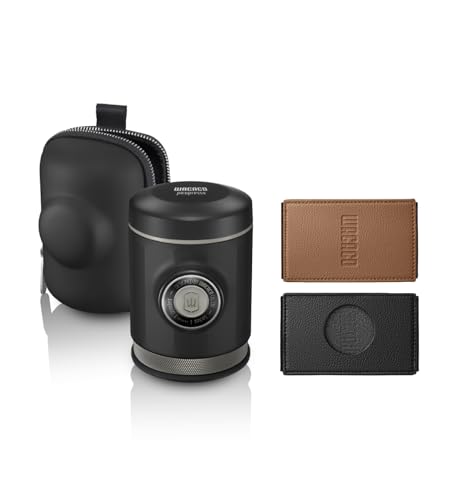
WACACO Picopresso Portable Espresso Maker with Protective Sleeve
A 52mm naked portafilter and an 18g basket, so it takes a normal espresso dose and a normal grind, unlike the smaller travel presses.
Best for: Someone who wants real espresso parameters in something that fits in a bag.
Check price
Flair 49 PRO Manual Lever Espresso Maker
A 49mm handled portafilter, a pressure gauge and no plastic in the brew path. You set the pressure profile by hand, which no machine under $2,000 lets you do.
Best for: People who want to control pressure directly and do not need speed or milk.
Check priceBudget bands are a guide; confirm the current price on Amazon. As an Amazon Associate we earn from qualifying purchases.
What pressure do these actually reach, and does it hold?
Reaching 9 bar is not the hard part. A lever gives you a long handle and your own bodyweight, which is far more force than the job needs, and the Flair 49 PRO puts a gauge on the head so you can read exactly where you are rather than guess. Holding a chosen pressure steadily for 25 seconds is the skill, and it is the thing that takes a few weeks to learn.
The published figures across this category are inconsistent, which is why the table below says "Not published" in several places rather than repeating marketing numbers. The travel presses quote peak pressures that are reached momentarily at the top of a stroke, which is a different claim from a pressure sustained through an extraction. The Flair 2GO is quoted at 9 bar by its manufacturer. The Flair 49 PRO does not need a claimed number at all, because the gauge tells you what you are doing on every shot.
Temperature is the variable that catches people out on levers, not pressure. There is no boiler holding a setpoint, so the brew temperature is whatever the water was when it went in, minus whatever the metal took out of it on the way through. A cold brew chamber can drop your water by a substantial margin in the seconds before the shot starts, which is why every lever maker comes with a preheat instruction and why skipping it produces a sour shot that no grind adjustment fixes. Preheat the chamber with hot water, dump it, then brew. That single habit is the difference between a lever that works and one that lives in a cupboard.
| Maker | Basket size | Water source | Claimed pressure | Needs power | Price |
|---|---|---|---|---|---|
| WACACO Nanopresso | Not published, smaller than a standard double | You pour in hot water from a kettle | Not published | No | Under $100 |
| WACACO Picopresso | 52 mm naked portafilter, 18 g | You pour in hot water from a kettle | Not published | No | Under $250 |
| Flair 2GO | Not published | You pour in hot water from a kettle | 9 bar, per the manufacturer | No | Under $250 |
| Flair 49 PRO | 49 mm handled portafilter | You pour in hot water from a kettle | Set by hand, read on the gauge | No | Under $500 |
| Breville Bambino (pump machine, for reference) | 54 mm portafilter | Onboard tank, heated by the machine | 9 bar at the group, regulated from a 15 bar pump | Yes, mains | Under $500 |
Sources: specifications from the manufacturers' published product pages and manuals (Breville, De'Longhi, Philips, Jura, Gaggia, Flair, WACACO); brew temperature and pressure targets follow published barista guidance such as the Specialty Coffee Association's. Prices are Amazon list prices checked in 2026. Researched, not tested in person.
The pump machine row is in the table on purpose, and reading across it is the whole argument of this page. The Breville Bambino at under $500 is under $100 less than the Flair 49 PRO, heats its own water in about three seconds, regulates a 15 bar pump down to 9 bar at the group, and has a steam wand. The only column it loses is the power one. If your reason for wanting a manual maker is anything other than that column or the ritual itself, the pump machine is the better buy and this page would be doing you a disservice to pretend otherwise.
Basket size is the specification to read before price. The WACACO Picopresso at under $250 is under $100 more than the Nanopresso and the difference is entirely in the basket: a 52 mm naked portafilter taking an 18 g dose, which is a normal espresso dose at a normal espresso grind. That means your recipe, your ratio and your grind setting all transfer from a real machine. On a smaller basket they do not, and you end up running a separate mental recipe for the travel device. The Picopresso machine page covers that in more detail.
What do you need alongside a manual espresso maker?
Two things, and the second one matters more than the maker itself.
First, a kettle. You are supplying the hot water, so you need something to heat it in and pour it accurately from into a small chamber. A gooseneck is genuinely useful here rather than a pourover affectation, because the target is narrow and you are pouring boiling water at chest height. A Cosori gooseneck electric kettle at under $100 has variable temperature presets and the counterweighted pour that makes filling a brew chamber uneventful. Note the irony worth naming out loud: the maker needs no power, and then most people plug in a kettle. Away from a socket, a camp stove and a stovetop kettle do the same job.
Second, a grinder, and here is the part people underestimate. The grinder matters MORE on a manual maker than it does on a pump machine, not less. A pump pushes water at a set pressure and keeps pushing regardless of what the puck does, which masks a certain amount of unevenness. A lever offers no such cushion: you feel the puck through the handle, and a bed with too many fines simply stalls under your hand while a bed with too many boulders collapses and gushes. The feedback is immediate and unforgiving, which is wonderful for learning and merciless if your grinder cannot deliver a consistent particle distribution.
A hand grinder is the natural partner, since the whole appeal of the setup is that nothing needs a socket. The TIMEMORE Chestnut C3 ESP at under $100 is the sensible floor: S2C conical burrs with an espresso-fine adjustment range, and roughly 50 to 70 seconds of cranking per dose. The 1Zpresso J-Ultra at under $250 has 48 mm burrs and an external numbered dial, gets the same dose done in under 30 seconds, and its numbered adjustment makes recording a setting trivial, which is exactly what you want when you are switching between a lever at home and a machine somewhere else. The hand grinder roundup compares them properly.
Add it up honestly. The Flair 49 PRO with the J-Ultra is under $1,000, and with the kettle it is under $1,000. That is not a budget setup. It is a considered one, and the money went somewhere unusual.
How long does one shot take, start to finish?
About 7 minutes from a cold start, and the extraction is the shortest part of it.
Roughly two minutes go to boiling water and preheating the brew chamber, which is not optional. Roughly a minute goes to grinding by hand, longer if you drink light roasts, which are dense and genuinely hard work at espresso fineness. About a minute goes to dosing, distributing and tamping. The shot itself is 25 to 30 seconds. Then two minutes go to knocking out the puck, rinsing the chamber, the basket, the piston and the screen, and drying the parts so nothing corrodes or holds stale coffee.
That last part is the one that sinks people. A pump machine takes a portafilter knock and a wipe. A lever is several separate components that all touched wet coffee, and they need attention every time rather than every week. Nothing about it is difficult, and it happens seven days a week.
Two drinks back to back is closer to 14 minutes, because almost every step repeats: grind again, preheat again, dose again, clean again. A pump machine makes the second shot in about ninety seconds. That difference is not a specification you can shop your way out of. It is the shape of the category.
None of which is an argument against manual espresso. It is an argument about what you are buying. Manual is a choice about how you want to spend five to seven minutes, not a cheaper route to the same result, and people who love these devices love them precisely because the time is the point.
What about travel and camping?
This is the case where manual makers are not a preference but the only option, and it is worth treating separately from the kitchen argument.
With no mains power there is no pump, no boiler and no super-automatic. What there is, is a lever, a hand grinder and a way to heat water. That chain works in a hotel room, at a desk, in a van or on a campsite, and it produces genuine espresso rather than a compromise brew. Nothing else in coffee does that.
The travel answers

Flair 2GO Collapsible Lever Espresso Machine
A collapsing lever press that reaches 9 bar and packs down flat, bridging travel presses and countertop levers.
Check price WACACO Picopresso Portable Espresso Maker with Protective Sleeve
A 52mm naked portafilter and an 18g basket, so it takes a normal espresso dose and a normal grind, unlike the smaller travel presses.
Best for: Someone who wants real espresso parameters in something that fits in a bag.
Check priceBudget bands are a guide; confirm the current price on Amazon. As an Amazon Associate we earn from qualifying purchases.
Between the two, the choice is about packing rather than about coffee. The Flair 2GO at under $250 is under $50 more than the Picopresso and collapses flat, bridging the gap between a pocket press and a countertop lever, so it suits a suitcase or a van build where flat packing matters more than small packing. The Picopresso is smaller and takes a full 18 g dose in a 52 mm naked portafilter, so it suits a bag and a person who wants their home recipe to transfer unchanged.
One thing to sort out before you travel with either: the water. A kettle is easy in a hotel and awkward on a mountain, and a lever with no hot water is an ornament. Plan that link in the chain first, because it is the one people forget until they are standing somewhere without it.
What can a manual maker never do?
Three things, and all three are permanent rather than a matter of technique.
Milk. There is no boiler, therefore no steam, therefore no textured milk. If you drink cappuccinos or lattes, a manual maker solves half your drink and leaves the other half to a separate appliance and a separate process. That is a much larger inconvenience than it sounds on a weekday morning.
Volume. One shot at a time, with a preheat before it and a cleanup after it. Four drinks for guests is nearly half an hour of standing at the counter working, and the first person to be served has finished their coffee before the last one gets theirs.
Convenience. No wake-up timer, no ready light, no one-button drink, nothing you can do while it works because you are the pump. The dialling in guide applies exactly as it does to a pump machine, with the extra variable that your own consistency on the handle is now part of the recipe.
If you want the manual experience with more mass, more temperature stability and a 58 mm basket, the Cafelat Robot is the other well regarded design in this space, and the Flair 49 PRO machine page covers the lever we recommend in more depth.
Who should not buy the Flair 49 PRO?
Anyone who wants a latte in the morning on a schedule. That is the clearest disqualification in the category and it is worth stating without hedging. The Flair 49 PRO is a weekend object for someone who enjoys the ritual: the preheat, the gauge, the feel of the puck through the handle, the fact that nothing is automated. If your actual requirement is a milk drink before work, a device with no steam capability that takes seven minutes per shot is going to be resented within a fortnight and put in a cupboard within two months.
What to buy instead is the Breville Bambino at under $500, which is under $100 cheaper than the Flair, heats in about three seconds, pulls a 9 bar shot from a 54 mm portafilter and has a real steam wand for milk. Paired with an under-$100 hand grinder the whole setup is under $500, against under $1,000 for the lever and a J-Ultra, and it makes more drinks in less time with milk capability the lever will never have.
Anyone buying a manual maker to save money should also reconsider. At under $500 the Flair costs more than an entry pump machine, so the saving does not exist at the top of this category. It exists at the bottom: the Nanopresso at under $100 and the Picopresso at under $250 are genuinely cheap ways into real espresso, and they are honest about being travel devices rather than kitchen machines.
And anyone whose grinder is a blade grinder or a budget filter burr should fix that first. A lever with a bad grinder is worse than a pump machine with a bad grinder, because there is no pump to force water through an uneven puck. The grinder is not an accessory to this purchase. It is the larger half of it.
We also have a full Flair 49 Pro review.
Frequently asked questions
What is the difference between a manual lever machine and an espresso press?
A manual lever machine such as the Flair 49 PRO uses a long lever and a handled portafilter on a stand, so your arm supplies steady pressure you can watch on a gauge. A handheld espresso press such as the WACACO Nanopresso or Picopresso builds pressure with a small hand pump and fits in a bag. Levers make better, more controllable shots at home; presses win for travel and camping.
What is the best manual espresso maker?
The Flair 49 PRO at under $500. It has a 49 mm handled portafilter, a pressure gauge so you can see and shape the pressure through the shot, and no plastic in the brew path. For travel, the WACACO Picopresso at under $250 is the better answer, because its 52 mm naked portafilter takes an 18 g dose and a normal espresso grind in something that fits in a bag.
Is manual lever espresso real espresso?
Yes. Espresso is defined by what happens in the basket: a fine grind, a compressed puck and roughly 9 bar of pressure driving hot water through it in 25 to 30 seconds. A lever generates that pressure from your arm instead of from a pump, and the puck cannot tell the difference. A well pulled lever shot has the same crema, body and extraction window as a pump machine shot.
What pressure do manual espresso makers reach?
Enough, and on a Flair you can see it. Conventional espresso is pulled at about 9 bar, and a lever reaches that easily because you have a long handle and body weight to work with. The interesting part is that pressure is not fixed: you can start gently to preinfuse and then build, which is manual pressure profiling, and no pump machine under about $2,000 lets you do it by hand.
How long does one manual espresso shot take?
Around seven minutes from a cold start, once you count everything. Roughly two minutes boiling water and preheating the brew chamber, a minute grinding by hand, a minute dosing and tamping, about half a minute of actual extraction and two minutes rinsing and drying the parts. Two drinks back to back is closer to fourteen, because most of that sequence repeats for the second shot.
Can a manual espresso maker steam milk?
No. There is no boiler and no steam, so a lever maker cannot texture milk at all. If you want cappuccinos and lattes you need either a machine with a steam wand or a separate milk device, and the milk half of the drink then becomes a second appliance and a second process. Manual espresso is fundamentally a black coffee proposition.
Do you need a special grinder for manual espresso?
You need a good one, and it matters more here than on a pump machine. A pump pushes water at a set pressure and masks a certain amount of unevenness in the puck. A lever gives you no such cushion, so a wide particle distribution shows up immediately as a shot that chokes or gushes. The TIMEMORE Chestnut C3 ESP at under $100 is the sensible floor for this setup.
How we choose: we compare published manufacturer specifications, verified owner reviews and published barista guidance. We do not test gear in person. Espresso machines run mains electricity, pressurised water and steam above boiling point, so follow your manufacturer's manual and leave electrical or boiler work to a qualified technician. Everything here is researched guidance, not professional advice.