Best Espresso Machine Under $500
The Gaggia Classic Evo Pro at under $500 is the best espresso machine under $500: a commercial 58 mm portafilter, a brass group and a solenoid valve in a machine you can rebuild rather than replace. If the budget has to cover a grinder too, buy the Breville Bambino at under $500 with a 1Zpresso J-Ultra hand grinder at under $250, a complete setup at under $500 that beats any single machine at the same price.
The Gaggia Classic Evo Pro at under $500 is the best espresso machine under $500, and it is also the last machine in this band you will ever need to replace. A commercial 58 mm portafilter, a brass group and a three-way solenoid valve, in a body you can open with hand tools, is an unusual amount of real machine for the money. It sits at the very top of the band on purpose: this page argues for the higher-value, longer-lived answer rather than the cheapest thing that technically makes espresso, and then shows what happens to the argument when the same $500 has to buy a grinder as well.
What actually separates espresso from hot coffee-flavoured foam?
Espresso is water forced through a compacted bed of about 18 g of finely ground coffee at roughly 9 bar of pressure, yielding about 36 g of liquid in 25 to 30 seconds. The word doing the work in that sentence is "through". The coffee bed has to be what resists the water. Once something else provides the resistance, you are no longer making espresso, whatever comes out of the spouts.
That is exactly what a pressurised basket does. It is a filter basket with a second plate behind it, pierced by a single small outlet. Coffee sits in the top layer, water passes through it easily, and the pressure builds against that small hole rather than against the puck. The stream emerges aerated and topped with foam that looks like crema. It tastes thin and bready, because the coffee barely resisted anything.
Pressurised baskets exist for a good commercial reason. They let a machine produce a respectable-looking drink from pre-ground supermarket coffee and a careless tamp, which is exactly what a first-time buyer will feed it. They lower the floor. What they also do is put a hard ceiling on the machine, because grind quality, dose accuracy and puck preparation stop mattering. You cannot improve a pressurised shot, only change it.
A non-pressurised basket, sometimes called a single-wall or precision basket, is a plain perforated cup. Water meets only the coffee. That means a bad grind gushes in 12 seconds and a too-fine grind chokes, and it also means every improvement you make is audible in the cup. This is the actual line under $500, and machines below about $200 do not cross it: they ship with pressurised baskets, a small thermoblock and a panarello sleeve on the steam wand that whips air into milk rather than texturing it.
The machines worth buying under $500

De'Longhi Dedica Arte Espresso Machine
Only 5.9 inches wide, which matters when counter space is the real constraint. A steam wand rather than a panarello, so latte art is possible.
Check price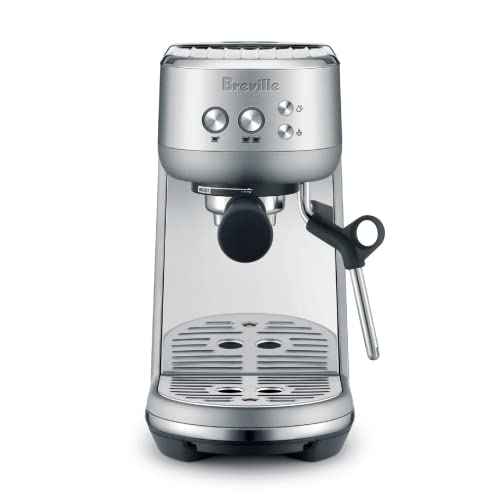
Breville BES450BSS Bambino Espresso Machine
The Bambino Plus without automatic milk texturing. Same 3 second thermojet and 9 bar extraction, and you steam by hand, which is a skill worth learning anyway.
Best for: The smallest budget that still buys genuine 9 bar espresso rather than a pressurised imitation.
Check price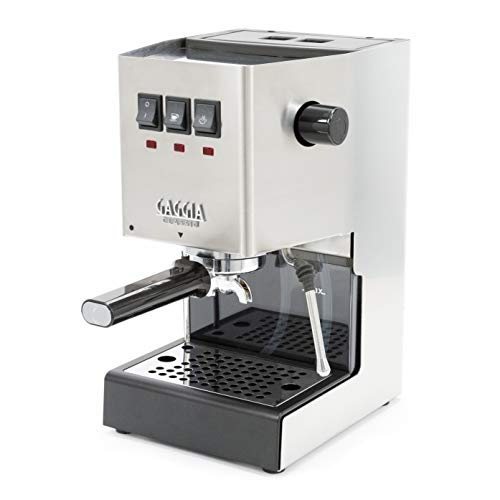
Gaggia RI9380/46 E24 Espresso Machine, Brushed Stainless Steel
A commercial 58mm portafilter and a three-way solenoid valve at the price of a plastic entry machine, which is the combination that makes a machine worth modifying later.
Check price
Gaggia RI9380/49 Classic Evo Pro Espresso Machine
A commercial 58mm portafilter, a brass group and a solenoid valve in a machine you can rebuild with hand tools. The modification community around it is enormous.
Best for: People who want a machine they can maintain and upgrade for years rather than replace.
Check priceBudget bands are a guide; confirm the current price on Amazon. As an Amazon Associate we earn from qualifying purchases.
No steam wand on your shortlist? Our best milk frother guide covers the NanoFoamer and Milk Cafe options for lattes without one.
Under a few hundred dollars, a lever can out-pull a cheap pump machine; compare the best manual espresso makers.
Which of these ships with a real basket?
Basket type and portafilter diameter are the two specifications that decide what a machine in this band can become. Diameter is a compatibility standard rather than a taste one, and it is not interchangeable, so it constrains every accessory you buy afterwards.
| Machine | Portafilter | Basket supplied | Price |
|---|---|---|---|
| Breville Bambino | 54 mm | Non-pressurised supplied | Under $500 |
| De'Longhi Dedica Arte | 51 mm | Pressurised supplied | Under $500 |
| Gaggia E24 | 58 mm | Pressurised supplied | Under $500 |
| Gaggia Classic Evo Pro | 58 mm | Both supplied | Under $500 |
The De'Longhi Dedica Arte at under $500 is the one to read carefully. It is only 5.9 inches wide, which genuinely matters when counter depth rather than budget is the binding constraint, and it has a real steam wand rather than a panarello, so latte art is possible. But it takes a 51 mm portafilter, an unusual size, and De'Longhi supplies pressurised baskets with it. Non-pressurised 51 mm baskets are an aftermarket purchase, and the accessory ecosystem at that diameter is thin.
The Breville Bambino at under $500 ships with non-pressurised 54 mm baskets and reaches brew temperature in about 3 seconds. Its stock stamped basket is the weakest part, and a 54 mm precision basket at under $50 is the cheapest measurable improvement available to a Breville owner.
Both Gaggias take the 58 mm commercial standard, which is the size every precision basket, naked portafilter, dosing funnel, puck screen and calibrated tamper is made in first. That is the quiet, durable advantage of the Gaggia Classic Evo Pro and the Gaggia RI9380/46 E24 Espresso Machine, Brushed Stainless Steel : hardware you buy today still fits the machine you upgrade to in five years. The portafilter basket size chart lists which machines take which diameter.
What does $500 buy as a complete setup?
Here is the uncomfortable part. A machine on its own is not a setup, and a non-pressurised basket is only an advantage if something is grinding fine enough to fill it properly. Below are six ways to spend roughly $500, with the total for each.
| Split | Machine | Machine | Grinder | Grinder | Total | Budget | Verdict |
|---|---|---|---|---|---|---|---|
| All on the machine | Gaggia Classic Evo Pro | under $500 | None, pre-ground coffee | None | under $500 | Under $500 | Best machine, worst coffee |
| Machine plus hand grinder | Breville Bambino | under $500 | Timemore Chestnut C3 ESP | under $100 | under $500 | Under $500 | The cheapest complete setup |
| Machine plus better hand grinder | Breville Bambino | under $500 | 1Zpresso J-Ultra | under $250 | under $500 | Under $500 | Best cup for exactly $500 |
| Smallest counter | De'Longhi Dedica Arte | under $500 | Timemore Chestnut C3 ESP | under $100 | under $500 | Under $500 | Needs a non-pressurised basket |
| Commercial group, tight budget | Gaggia E24 | under $500 | Timemore Chestnut C3 ESP | under $100 | under $1,000 | Over $500 | 58 mm accessories fit forever |
| Top of band plus grinder | Gaggia Classic Evo Pro | under $500 | 1Zpresso J-Ultra | under $250 | under $1,000 | Over $500 | The setup to grow into |
The first row is the trap. Spending the entire $500 on the Gaggia Classic Evo Pro leaves nothing for grinding, and pre-ground coffee is milled for drip: far too coarse for 9 bar, so it gushes through a non-pressurised basket in 12 to 15 seconds and tastes sour and thin. It is also stale, because ground coffee loses its aromatics within days. You would have bought the best machine in the band and be drinking the worst coffee on the page.
The third row is the best cup for exactly $500. The Breville Bambino at under $500 with the 1Zpresso J-Ultra at under $250 totals under $500. That hand grinder has external numbered adjustment and grinds an espresso dose in well under 30 seconds, which is genuinely enough resolution to move a shot by two or three seconds at a time. No electric grinder near under $250 does that as well.
The second row is the cheapest complete setup that is honestly worth owning: under $500 for the Bambino and the Timemore Chestnut C3 ESP at under $100, with under $250 left for a scale and a distribution tool. Hand grinding costs you roughly 30 to 60 seconds of cranking per double, every single time, and that is the real trade rather than any deficiency in the grind. The hand grinder roundup covers that decision on its own terms.
The last row, under $1,000 for the Gaggia Classic Evo Pro and the J-Ultra, is over budget and is what most people who start here end up owning within eighteen months. If you can see that coming, buying the Gaggia now and the grinder next quarter is a reasonable plan. Buying the Gaggia now and no grinder ever is not.
Why the Gaggia Classic Evo Pro rather than the cheaper Bambino?
Because under $250 buys a different class of object. The Bambino is a well made appliance: fast, small, forgiving, and eventually disposable. The Gaggia Classic Evo Pro is a small commercial machine wearing a home body. Its brass group holds heat, its 58 mm portafilter is the industry standard, its three-way solenoid valve depressurises the puck so it knocks out dry, and there is an enormous modification community around it selling PID kits, over-pressure valves set to 9 bar and precision baskets.
The honest cost of that choice is convenience. The Gaggia has no PID as sold, so brew temperature is thermostat controlled and drifts more than a Breville does, and you learn the machine's rhythm or you fit a kit. It takes minutes rather than seconds to warm up. Its steam wand is capable but entirely manual. None of that is a defect at under $500. It is what an appliance-shaped machine trades away to be easy.
If you want easy, buy the Bambino , and add the Baratza Encore ESP at under $250 for a under $500 electric setup that needs no cranking. If you want the machine to still be on the counter in 2036, buy the Gaggia. Both are correct answers to different questions, and the beginner coffee bar setup prices out the complete build around either one, accessories included.
Who should not buy at the top of this band?
Anyone whose $500 has to cover the grinder too. The Gaggia Classic Evo Pro at under $500 is the best machine here and the wrong purchase for a reader with exactly $500 and nothing else. Buy the Bambino and a hand grinder instead. You will pull better shots on day one and every day after, and the machine upgrade can wait until it is affordable on its own.
Anyone who has not accepted the routine. Every machine on this page asks you to weigh 18 g of beans, grind them, distribute them in the basket, tamp level, pull the shot on a timer, then texture milk by hand and wipe the wand immediately. That is about four minutes for the first drink and about ninety seconds once it becomes habit. It is a hobby with a beverage attached, and that is a feature for some people and a chore for others.
Anyone who wants milk drinks in under two minutes with no technique should skip this band entirely. This is the clearest case on the page. If the goal is a latte at a button press before work, no machine here delivers it, and buying one produces an expensive appliance you resent. A bean to cup super-automatic grinds, doses, tamps, brews and textures milk on one button, and the honest trade is that you give up control of dose, ratio and grind, which caps the quality. That is a reasonable trade for a great many households. The super-automatic roundup is where that reader should go, and starts under $500.
And anyone who was about to buy a $150 machine as a test. That machine will ship with a pressurised basket and a panarello wand, and it will teach you that home espresso is disappointing rather than that cheap espresso is. If under $500 is genuinely out of reach right now, a hand grinder at under $100 plus a manual lever press is a better use of the money than a bad pump machine, because the grinder carries forward into whatever you buy next.
What else do you need before the first shot?
Three things, and they total under $250. A scale reading to 0.1 g with a timer at under $50, because without a known dose the brew ratio that defines the drink is a guess. A tamper that actually matches your basket diameter, which is where the 51, 54 and 58 mm question bites again. And a distribution tool, because clumps thrown into the basket by any grinder are where channels start, and channels are the most common cause of a sour shot at any price.
Beans matter more than most beginners expect and less than the internet claims. Espresso wants beans roughly 7 to 21 days off roast: before that, carbon dioxide from roasting disrupts extraction, and after it the coffee stales. Start on something forgiving such as Lavazza Super Crema Whole Bean Coffee, 2.2 lb at under $25, which is an arabica and robusta blend that produces thick crema and tolerates a dose or grind error. A 2.2 lb bag is roughly 60 doubles, which is about what learning to dial in actually costs you in wasted shots.
Water is the line people skip and then blame the machine for. Espresso machines scale from calcium and magnesium, and the commonly cited target is roughly 50 to 100 ppm total hardness as calcium carbonate with alkalinity near 40 ppm. Above about 120 ppm, filtration or blended distilled water is the right answer rather than descaling more often, because scale on a heating element is what kills cheap machines long before anything else does.
What does this budget genuinely not buy?
Simultaneous brewing and steaming. Every machine here runs a single boiler that cannot be at brew temperature and steam temperature at the same time, so you pull the shot, wait for it to climb, texture the milk, then wait or purge before the next shot. That is fine for one or two drinks and irritating at four.
A built-in grinder. All-in-one machines with an integrated grinder start under $1,000, and assisted tamping starts under $1,000. If one footprint on the counter is a hard requirement, that is the band you actually need, and the best espresso machines under $1,000 covers it with the same budget arithmetic applied one tier up.
Temperature you never think about. PID control on both the brew and steam circuits starts well above this band. Under $500 you are managing temperature yourself, either by trusting a fast thermoblock or by learning a boiler's rhythm. That is a completely workable way to make excellent espresso, and it is why weighing the dose and timing the shot matter more here than they do on a $1,600 machine, not less.
We also have full reviews of each: Breville Bambino review and De'Longhi Dedica Maestro Plus review.
Frequently asked questions
What is the best espresso machine under $500?
The Gaggia Classic Evo Pro at under $500. It uses a commercial 58 mm portafilter, a brass group and a three-way solenoid valve, so every precision basket, naked portafilter and calibrated tamper on the market fits it, and it can be rebuilt with hand tools rather than replaced. It sits at the very top of the band, which means the grinder has to come out of a later budget.
What is the best espresso machine for beginners?
This price band is the beginner band, and the two answers are the Breville Bambino at under $500 if you want the machine to be easy, and the Gaggia Classic Evo Pro at under $500 if you want it to last. The Bambino heats in about 3 seconds and forgives more. The Gaggia asks more of you and rewards it for a decade. Both pull genuine 9 bar espresso through a non-pressurised basket.
What is a pressurised basket and should I avoid one?
A pressurised basket has a second plate with one small outlet behind the filter, so it builds back pressure and forces the coffee through a valve. That generates crema from almost any grind, including pre-ground supermarket coffee. It is why cheap machines seem to work, and it is also why they never improve: grind quality is masked entirely. Use one to start, then move to a non-pressurised basket.
Can you get real espresso for under $200?
Not reliably. Machines under about $200 almost universally ship with pressurised baskets, small thermoblocks and steam wands with panarello sleeves that froth rather than texture. They produce hot, coffee-flavoured foam that looks correct. The line between that and espresso is a non-pressurised 51, 54 or 58 mm basket fed by a burr grinder, and under $500 is where that combination becomes available.
Should I buy a $500 machine or a $300 machine and a grinder?
The $300 machine and the grinder, almost every time. Grind size is the only variable that meaningfully controls shot time, so an under-$500 machine fed pre-ground coffee cannot land a 25 to 30 second shot. A Breville Bambino at under $500 with a 1Zpresso J-Ultra hand grinder at under $250 costs under $500 together and makes better espresso than any single machine at that price.
Is a hand grinder good enough for espresso?
Yes, and at this budget it is usually the better buy. A Timemore Chestnut C3 ESP at under $100 or a 1Zpresso J-Ultra at under $250 grinds fine enough and adjusts precisely enough for 9 bar, which no electric grinder does at those prices. The cost is effort: about 30 to 60 seconds of cranking per double, every time, which some people enjoy and some quietly resent.
How we choose: we compare published manufacturer specifications, verified owner reviews and published barista guidance. We do not test gear in person. Espresso machines run mains electricity, pressurised water and steam above boiling point, so follow your manufacturer's manual and leave electrical or boiler work to a qualified technician. Everything here is researched guidance, not professional advice.